Prof. Dr. Thorsten Jungmann (last updated 2026-11-02)
Relates to FTS-02 The Sustainable Development Goals and the criteria of scientific work
Task
In phase 1, you examine a question about one of the 17 Sustainable Development Goals (SDGs) of the United Nations (UN) with the didactic concept in five steps. You present the result on a poster and in an elevator talk. In this way, you practise on a small scale what you will do on your own in your term paper in phase 3.
Procedure
Phase 1 runs over three sessions:
- FTS-02 on 16 October, ‘Introduction, Grouping up & First Step’: In the exercise time, you sign up for one SDG by joining its group in ILIAS; each SDG has five places. Choose your SDG by interest: in phase 3, you can link your term paper to it. Then you choose one of the three questions for your SDG and write down your own answer (steps 1 and 2).
- Until FTS-03: On your own, you put your question to the artificial intelligence (AI) service of your SDG and check the sources it names (step 3). You read the texts of the source package of your SDG and note where each statement comes from (step 4).
- FTS-03 on 23 October, ‘Elaboration & Poster design’: You weigh up the three answers (step 5) and design your poster.
- By Wednesday 28 October 2026 at 23:55: You upload your poster in ILIAS.
- FTS-04 on 30 October, ‘Elevator talk’: Grouped by SDG, you present in an elevator talk, briefly and concisely, in 60 to 90 seconds, your question, your own answer, what the scientific sources say, how the AI answer fits in, and the insight you take away from the exercise. The posters are displayed alongside, and everybody can view them in ILIAS.
The five steps
In phase 1, you take the five steps of the didactic concept for a question about your SDG. Steps 1 to 4 are explained with an example in FTS-02, chapter 5.
1 Question
Before you choose, read the section on your SDG in FTS-02, chapter 3. Then choose one of the three questions for your SDG. The source package of your SDG is tailored to these three questions. Use your question word for word: in step 3, you put it to the AI service exactly like this, and it forms the header of your poster.
| SDG | Question a | Question b | Question c |
|---|---|---|---|
| 1 No poverty | Does access to electricity lift rural households out of poverty? | Do mobile payment services reduce poverty? | Do jobs in export factories reduce poverty in the producing countries? |
| 2 Zero hunger | Can precision farming produce more food with fewer resources? | Can vertical farming help to feed cities? | Can cold chains reduce food losses in developing countries? |
| 3 Good health and well-being | Do exoskeletons protect industrial workers from back injuries? | Do collaborative robots make factory work healthier? | Does shift work harm the health of industrial workers? |
| 4 Quality education | Does learning with AI chatbots improve students’ learning? | Can virtual reality make training in industry more effective? | Does online learning work as well as learning on campus? |
| 5 Gender equality | Are cars as safe for women as for men? | Do gender-diverse teams make companies more innovative? | Can companies increase the share of women in engineering jobs? |
| 6 Clean water and sanitation | Can seawater desalination solve water scarcity sustainably? | Do semiconductor factories endanger the water supply of their regions? | Can factories run on recycled water? |
| 7 Affordable and clean energy | Can a power system run on 100 % renewable energy? | Can heat pumps supply the process heat of industry? | Are batteries or hydrogen the better way to store renewable energy? |
| 8 Decent work and economic growth | Do industrial robots destroy jobs? | Can economic growth be decoupled from carbon dioxide (CO₂) emissions? | Does working from home make people less productive? |
| 9 Industry, innovation and infrastructure | Does Industry 4.0 make factories more sustainable? | Does bringing production back to Europe make industry more resilient? | Is rail freight more sustainable than road freight in practice? |
| 10 Reduced inequalities | Does automation widen the income gap? | Does the emigration of skilled workers harm their home countries? | Do AI tools in recruiting discriminate against applicants? |
| 11 Sustainable cities and communities | Do e-scooters make urban transport more sustainable? | Will self-driving cars reduce traffic in cities? | Is building with wood more climate-friendly than building with concrete? |
| 12 Responsible consumption and production | Is remanufacturing better for the environment than recycling? | Is bioplastic better for the environment than conventional plastic? | Does repairing old devices save more resources than buying efficient new ones? |
| 13 Climate action | Are electric cars better for the climate than cars with combustion engines? | Can carbon capture make cement production climate-neutral? | Does a price on CO₂ make industry cut its emissions? |
| 14 Life below water | Can alternative fuels make shipping climate-neutral? | Do offshore wind farms harm marine life? | Can technology clean the oceans of plastic? |
| 15 Life on land | Does lithium mining for batteries destroy ecosystems? | Can solar parks and biodiversity go together? | Do wind turbines kill too many birds and bats? |
| 16 Peace, justice and strong institutions | Can supply chain laws stop human rights violations by suppliers? | Do rules against conflict minerals help the people in mining regions? | Can blockchain prevent fraud in supply chains? |
| 17 Partnerships for the goals | Does joining the UN Global Compact make companies more sustainable? | Do companies with climate targets actually cut their emissions? | Does foreign direct investment bring new technology to developing countries? |
2 Your own answer
In the session, before you consult the AI service or your source package, you write down your own answer in a few sentences: What do you think – and why? Everything you already know counts, including what you have heard in the session. Distinguish what you know from what you assume: ‘I know that …’, ‘I assume that …’, ‘I am not sure whether …’. Keep your own answer as you wrote it, for example in a document in your folder for this module. On your poster, it stands unchanged in the middle section and shows where you started from (FTS-02, 5.2).
3 AI answer
Until FTS-03, you put your question word for word to the AI service that is specified for your SDG:
| SDG | AI service | Access |
|---|---|---|
| 1, 7, 13 | ChatGPT | https://chatgpt.com |
| 2, 8, 14 | Perplexity | https://www.perplexity.ai |
| 3, 9, 15 | Claude | https://claude.ai |
| 4, 10, 16 | Gemini | https://gemini.google.com |
| 5, 11, 17 | Vibe by Mistral AI | https://chat.mistral.ai |
| 6, 12 | Grok | https://grok.com |
If registering with this service is an obstacle for you – some services ask for a mobile phone number, for example – use the chat service with artificial intelligence of HSBI (HSBIKI) instead: HSBIKI Chat at https://www.hsbi.de/dvz/hsbiki/chat
Save the complete answer, together with the date, the name of the service and, where the service shows them, the model and the mode, for example an instant or a thinking mode. Then check the answer like a reviewer (FTS-02, 5.3):
- Which sources does the AI service name? List all of them.
- Do these sources exist?
- Do the sources say what the AI service claims?
4 Scientific answer
Until FTS-03, you read the texts of the source package of your SDG in the Zotero group FTS-resources-1. Read each text in passes: overview, content, depth (FTS-02, 5.4). Note every statement that you want to use in your own words, with the short reference and the page, and distinguish what the authors have found from what they assume or recommend. From your notes, you formulate the scientific answer to your question.
5 Weighing up
In FTS-03, you weigh the three answers against each other: Where do they agree, where do they contradict each other, and why? The result is your balanced, reflective answer. You learn how to weigh up in FTS-03.
Result
Your poster is a single slide in landscape format with a fixed layout:
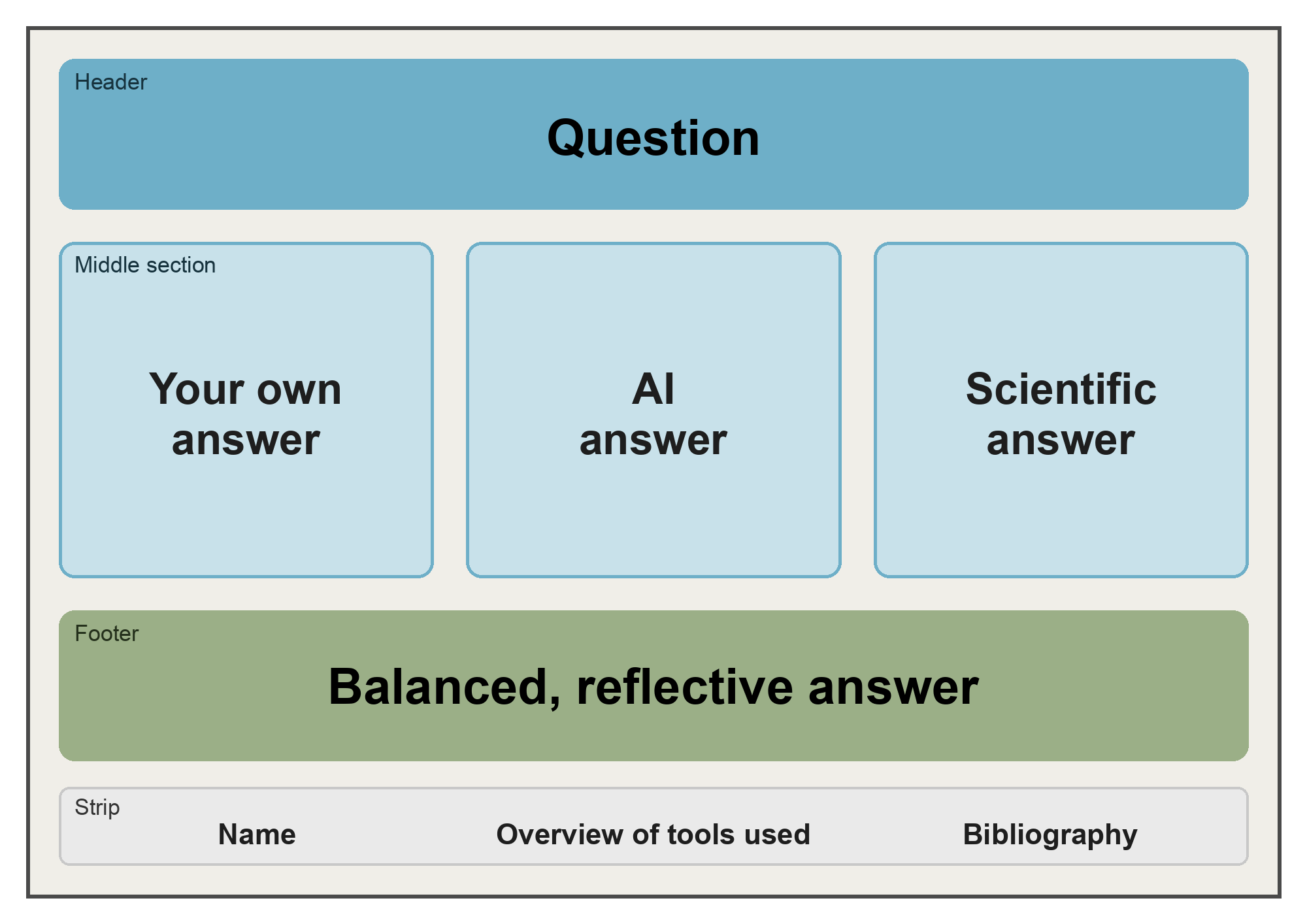
- Header: your question, word for word.
- Middle section: three columns side by side – your own answer, the AI answer and the scientific answer.
- Footer: your balanced, reflective answer.
- Strip at the bottom: your name, your overview of tools used and your bibliography.
You learn what makes a good poster in FTS-03. In the elevator talk in FTS-04, you present your question, your own answer, what the scientific sources say, how the AI answer fits in, and the insight you take away from the exercise.
Requirements
- AI service: the service specified for your SDG; HSBIKI Chat only if registering with it is an obstacle for you.
- Scientific sources: In phase 1, you take the scientific sources for your poster from the source package of your SDG; you do not search the internet for them.
- Your own answer: written in the session, before you consult the AI service or your source package, and on your poster as you wrote it.
- The AI answer is never a source and never evidence: you quote it only to examine it – verbatim in quotation marks or paraphrased, always with the long reference directly at the quotation (the product, the access source, the model and the mode and the date of your query) and with the note that the quotation is not evidence. It never gets a short reference, and its long reference stands nowhere else.
- Data and facts never come from the AI service: they come from a scientific source, or you do not use them.
- Citing: Every statement from a scientific source carries its short reference with the page, according to the guide to Scientific Work. You learn in FTS-03 how to cite on the poster and where the bibliography and the table ‘Overview of tools used’ go on it.
- Pictures: Every picture on your poster that you have not created yourself carries its source.
Submission
Upload your poster as a single file in the Portable Document Format (PDF) in the exercise ‘Poster upload’ in the group of your SDG in ILIAS, by Wednesday 28 October 2026 at 23:55.