Prof. Dr. Thorsten Jungmann (last updated 2026-11-03)
Overview of this lesson
What is this lesson about? – The guiding questions:
- How do you weigh up your three answers into a balanced, reflective answer?
- What makes a good scientific poster, and what belongs on yours?
- How do you cite everything on your poster that does not come from you?
- How do you present your poster in an elevator talk?
What will you be able to do at the end of this lesson? – The intended learning outcomes:
- You check the answer of the artificial intelligence (AI) against the scientific sources, compare the three answers and weigh them up into a balanced, reflective answer with claim, evidence and conclusion.
- You design your poster in the fixed layout from the template and decide what belongs on it and what does not.
- You cite every element on your poster that does not come from you – statements, figures, pictures and AI output – according to the guide to Scientific Work.
- You structure your elevator talk on your question and your balanced, reflective answer.
What will you know at the end of this lesson? – The building blocks of knowledge:
- Weighing up: claim, evidence, conclusion
- The balanced, reflective answer
- Posters in science
- What makes a good scientific poster
- Layout, content and template of your poster
- Citing statements, AI output, figures and pictures
- Bibliography and overview of tools used on the poster
- The structure of the elevator talk
How is the content organized? – The structure:
- 1 Three answers, one conclusion – Weighing up
- 2 Ten seconds to win a reader – What makes a good scientific poster
- 3 Your poster step by step – Layout, content and template
- 4 Whose words, whose picture? – Citing everything that is not your own
- 5 Your poster in a nutshell – The elevator talk
- 6 What have you learnt today? – Summary and answers to the guiding questions
Review of the previous lesson
In the previous lesson, you got to know the Sustainable Development Goals and the criteria of scientific work.
- The 17 Sustainable Development Goals (SDGs) of the 2030 Agenda are broken down into targets, which are measured with indicators; companies and their employees contribute to achieving them.
- Thirteen general criteria, from relevance to fairness, distinguish scientific work from everyday opinions and journalistic texts.
- Steps 1 to 4 of the didactic concept: a good question, your own answer before any source, the AI answer, checked and quoted only to examine it, and the scientific answer with short reference and page.
- Phase 1 runs from your question about your SDG to your poster and your elevator talk.
Today, you take step 5 and turn your three answers into a poster.
1 Three answers, one conclusion – Weighing up
1.1 Claim, evidence, conclusion
Since FTS-02, you have collected three answers to your question: your own answer, the answer of an artificial intelligence (AI) service – the AI answer – and the scientific answer from your source package. Step 5 of the didactic concept brings them together. You weigh the three answers against each other, and the result is your balanced, reflective answer – the footer of your poster.
Weighing up is not a matter of taste. It follows the criterion of logical argumentation (FTS-02, 4.7): claims must be supported by evidence, and conclusions should follow compellingly from the data presented (Jungmann 2025, p. 17). This gives your balanced, reflective answer its structure. What it says about your question is a claim (German: Behauptung), each claim rests on evidence (German: Beleg) from a scientific source, and your conclusion (German: Schlussfolgerung) follows from this evidence. It derives directly from the results, answers only the question you asked and names its limitations (Gundogan et al. 2016, p. 70).
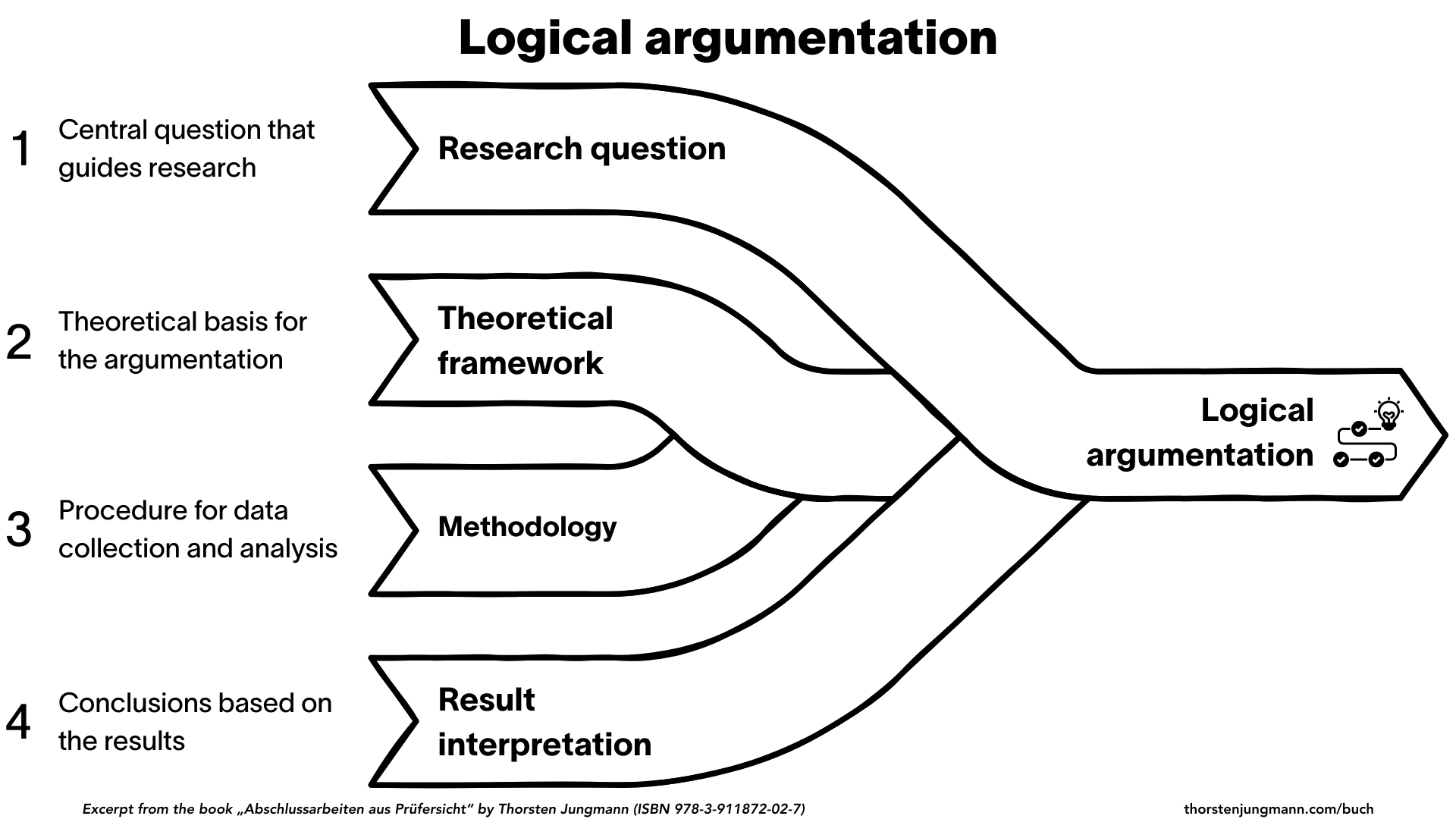
Figure: English version of the figure in Jungmann (2025, p. 17)
Take our example question from FTS-01 and FTS-02, ‘Does hydrogen make steel production climate-neutral?’ Its two scientific sources from FTS-02, 5.1, Vogl et al. (2018) and Nikoleris (2019), carry a claim like this:
| Part | Example from the hydrogen question |
|---|---|
| Claim | Hydrogen can make steel production almost free of emissions. |
| Evidence | If renewable electricity is used, steelmaking by hydrogen direct reduction has essentially zero emissions (Vogl et al. 2018, p. 736). Zero-emission electricity alone is not enough for zero-emission steel: carbon dioxide (CO₂) still comes, for example, from mining iron ore and limestone, from making lime and from the carbon that steel needs (ibid., p. 740). |
| Conclusion | Almost free of emissions, but not entirely – and how close it comes depends on the electricity. |
Note what the conclusion does not do. It does not say ‘yes’, although the first half of the evidence would invite it, and it does not say ‘no’ either. It says exactly as much as the evidence carries.
1.2 Your own answer against all the evidence
How do you get from three answers to one? Lay them side by side and ask:
- Where do the three answers agree?
- Where do they contradict each other – and why?
- Which claim rests on which evidence?
- What remains open?
Take your own answer seriously, and test it against all the evidence, including the evidence that contradicts it. This is objectivity: set your personal convictions aside and do not cite only those sources that support your own position (Jungmann 2025, p. 14). And it is reflexivity: question your own assumptions (ibid., p. 21). Your own answer from step 2 shows you where you started from; in step 5, you see what you have learnt since (FTS-02, 4.11).

Image by Qwen-Image 2.1
The AI answer needs special care. In step 3, you checked whether the sources it names exist and say what it claims. When you weigh up, the AI answer is one of three answers, but it is never evidence: the guide to Scientific Work does not allow data and facts from AI output (section 2.10). It can, however, point you to evidence: if the AI has researched properly and names real sources, these sources can be a starting point for finding a real answer – but always check them yourself. In phases 1 and 2, the scientific sources for your poster come from your source package; in phase 3, where you choose your sources yourself, real sources that the AI names can be among them. Where the AI answer agrees with your scientific sources, the evidence comes from the sources. Where the AI makes a claim that none of your sources supports, this is a finding in itself – you report it, but you do not use the claim.
Back to the example. The example of your own answer in FTS-02, 5.2 said that hydrogen produces only water. The scientific answer confirms this for the reduction of the iron ore: hydrogen reduces the ore to iron, and water is formed (Vogl et al. 2018, p. 738). But your own answer did not know where the hydrogen comes from – and that is decisive: producing one tonne of liquid steel takes 3.48 MWh of electricity, most of it for making the hydrogen by electrolysis (ibid., p. 736).
1.3 Your balanced, reflective answer – an example
Your balanced, reflective answer (German: abgewogene, reflektierte Antwort) stands in the footer of your poster, and it is the core of your elevator talk. It answers your question in its first sentence, as clearly as the evidence allows. Then it names the conditions and the limits, each with its short reference, because a conclusion acknowledges its obvious limitations (Gundogan et al. 2016, p. 70). Finally, it reflects: how does your own answer compare with what the sources say, how does the AI answer fit in – and what do you take away?
A balanced, reflective answer – an example
Almost, but not entirely. With renewable electricity, steelmaking by hydrogen direct reduction has essentially zero emissions (Vogl et al. 2018, p. 736); with a power grid that emits more than 532 kg of CO₂ per megawatt-hour and without scrap, it emits more than the blast furnace route (ibid., p. 740). Even with zero-emission electricity, some CO₂ remains, for example, from making lime (ibid., p. 740). My own answer was right that the reduction with hydrogen produces water, and it said openly that it did not know where the hydrogen comes from – which turns out to be decisive. The AI answer came to a similar result but named no sources, and some of its figures were not confirmed.
This example is short – a footer is not a chapter. Yet it contains everything that makes an answer balanced: a clear answer, the conditions under which it holds, the evidence for each statement and its limits. And it is reflective, because it says what has changed compared with your own answer and how the AI answer fits in.
Avoid two traps. The first is the answer that simply repeats one of the three answers, for example the scientific one. It is evidence, but it is not yet weighed up. The second is the answer that goes beyond the evidence, for example ‘hydrogen makes all steel climate-neutral’. No source in our example says this; such a sentence would be a claim without evidence.
2 Ten seconds to win a reader – What makes a good scientific poster
2.1 Posters at scientific conferences
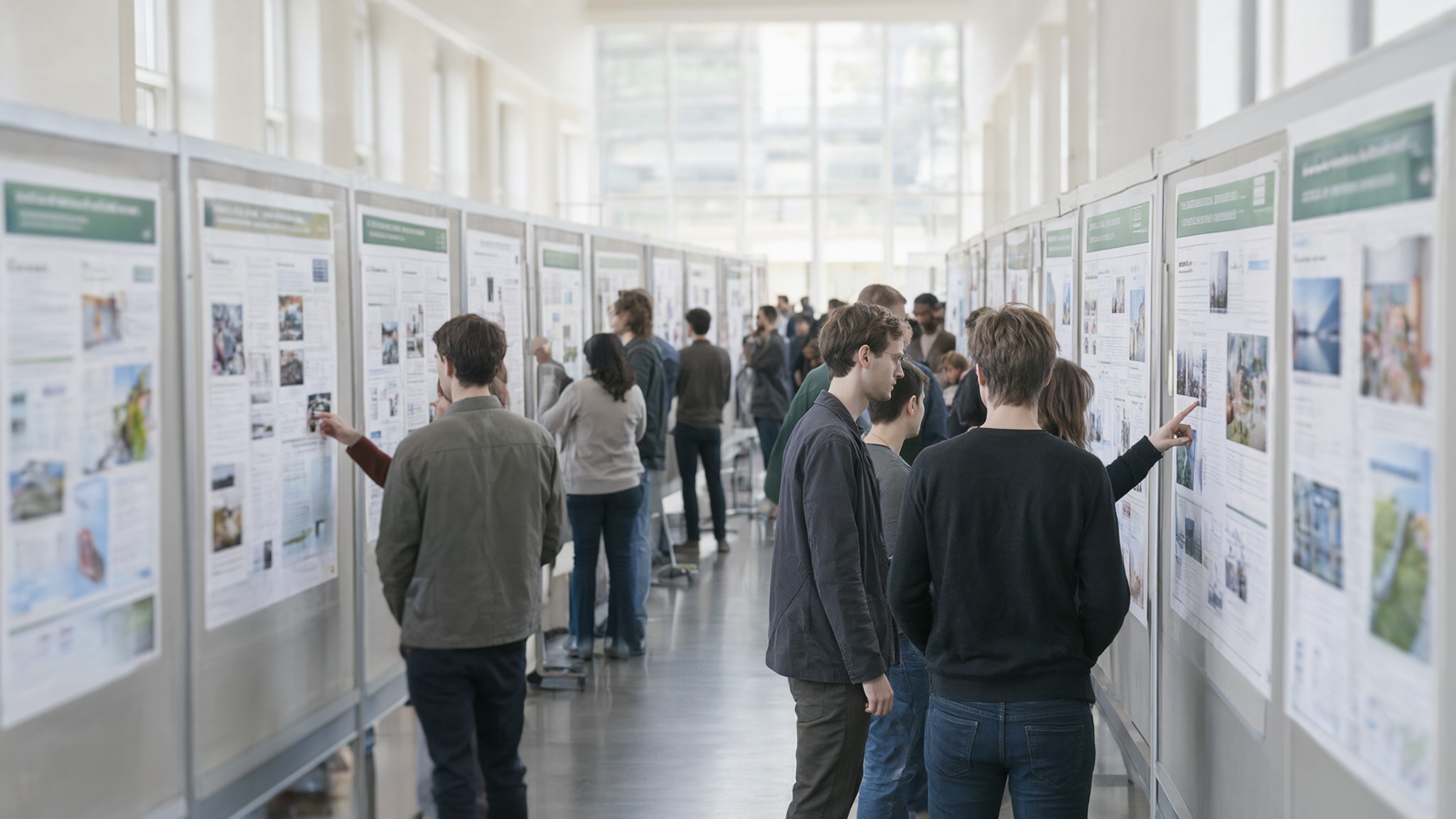
Image by Qwen-Image 2.1
Why posters at all? In science, posters are one of the main ways of presenting your work at conferences (Gundogan et al. 2016, p. 69). Erren and Bourne (2007, p. 777) see them as central to how researchers communicate their work and as important for a successful career in science; many lifelong collaborations, they write, began in front of a poster board (ibid., p. 777). A good poster, well presented, can raise your standing with colleagues, and prizes for posters count in a curriculum vitae (ibid., p. 778).
The picture shows the classic form: a large printed poster on a board, and in front of it the people who want to know more. More and more conferences also use the electronic poster (German: elektronisches Poster): a screen shows the poster instead of paper (Gundogan et al. 2016, p. 71).
In this module, too, your poster is electronic. In FTS-04, I show the posters on the projector, grouped by Sustainable Development Goal (SDG), while you give your elevator talk, and everybody can view all posters in ILIAS. The poster in phase 1 is therefore more than an exercise for this module.
2.2 A snapshot that starts a conversation
A poster is not a paper on a wall. Erren and Bourne (2007, p. 777) describe it as a snapshot of your work that is meant to engage others in a dialogue about it – or, if you are not there, a summary that makes the reader want to learn more. Readers of a poster, unlike the audience of a talk, may move on at any moment – one more reason why a poster depends on a clear design and on content reduced to its core (Gundogan et al. 2016, p. 69).
You have only a few moments to win a reader. Erren and Bourne (2007, p. 777) compare this to the ride in an elevator: a few seconds to raise someone’s interest. One approach they suggest is to present the work as an answer to a decisive question and to focus the poster on answering this question clearly and concisely (ibid., p. 777). Keep the title brief and clear to a wide range of readers: it works like the headline of a newspaper and may even pose the decisive question itself (ibid., p. 777).
Your poster in this module does exactly that. Its header states your question, word for word; its middle section shows the three answers you have collected; its footer gives your balanced, reflective answer. When you distil your work for a poster, its message and its line of argument have to survive (ibid., p. 777). For you, distilling means choosing: from everything you have read, only what answers your question goes on the poster.
2.3 The 13 criteria on a single slide
Your poster is a piece of scientific work, so the 13 general criteria of scientific work from FTS-02, chapter 4 apply to it as they apply to your term paper. On a single slide, some of them become particularly visible:
| Criterion | What it means on your poster |
|---|---|
| Logical argumentation | Your balanced, reflective answer consists of claims, evidence and a conclusion that follows from the evidence. |
| Objectivity | You consider all the evidence, including the evidence against your own answer. |
| Reflexivity | Your balanced, reflective answer says how your own answer compares with what you have learnt since. |
| Honesty | Your own answer stays as you wrote it and apart from the ideas of others; every picture that you have not created yourself carries its source. |
| Traceability | A reader can see which artificial intelligence (AI) service you asked, when and with which question. |
| Verifiability | Every statement from a scientific source carries its short reference with the page. |
| Comprehensibility | Everybody who reads your poster understands your question and your balanced, reflective answer. |
Each row takes up what the criterion requires in general. Logical argumentation requires that claims are supported by evidence (Jungmann 2025, p. 17); objectivity, that you present different perspectives fairly (ibid., p. 14); honesty, that you distinguish your own ideas from those of others and acknowledge their intellectual property by citing correctly (ibid., p. 15). Traceability requires that others can understand your entire work process (ibid., p. 16), verifiability that they can verify or refute your results (ibid., p. 20), and comprehensibility asks for clear, precise language (ibid., p. 22).
The table is not a complete list. Relevance, originality, validity, reliability, responsibility and fairness apply to your poster as well – here, they simply show less on the surface. How to keep your poster clear is the subject of the next section.
2.4 Less is more: text, space and legibility
Erren and Bourne (2007, p. 778) put a rule for the content into one sentence: ‘Everything on the poster should help convey the message.’ The text meets the standards of good scientific writing – it is clear and precise and uses as few words as possible – and graphics serve to portray complexity clearly, not to impress (ibid., p. 778). Do not overload your poster with formatting and pictures, because they distract from the content; state the key points (Gundogan et al. 2016, p. 69).
For the text, Gundogan et al. (2016, p. 70) recommend about 100 words per section and warn that too much text puts readers off. Your poster has five main text areas – the header, the three columns and the footer – so be economical in each of them. Your own answer is the exception: it stays as you wrote it.
For space and order, Erren and Bourne (2007, pp. 777–778) recommend leaving white space (German: Weißraum) instead of filling every corner and guiding the reader’s eye from one part to the next in a logical order. The fixed layout of your poster already does the guiding: from the question at the top via the three answers to your balanced, reflective answer at the bottom.
For legibility, use contrasting colours and no more than two colours for the main text (Gundogan et al. 2016, p. 70). Choose figures and images of good resolution, so that nothing blurs (ibid., p. 70). Erren and Bourne (2007, p. 778) recommend never using a font smaller than 24 points on a printed poster; Gundogan et al. (2016, p. 70) name 24 points for the text and 32 points for headings as usual sizes. The template of your poster has the size A0, so these sizes apply to it.
Before you upload your poster, look at it as a file in the Portable Document Format (PDF) on your screen at the size of a whole page. In FTS-04, the projector shows your poster in the same way – as one page on one screen.
3 Your poster step by step – Layout, content and template
3.1 Header, middle section, footer
The layout of your poster is fixed. You know it from FTS-01, 3.4:
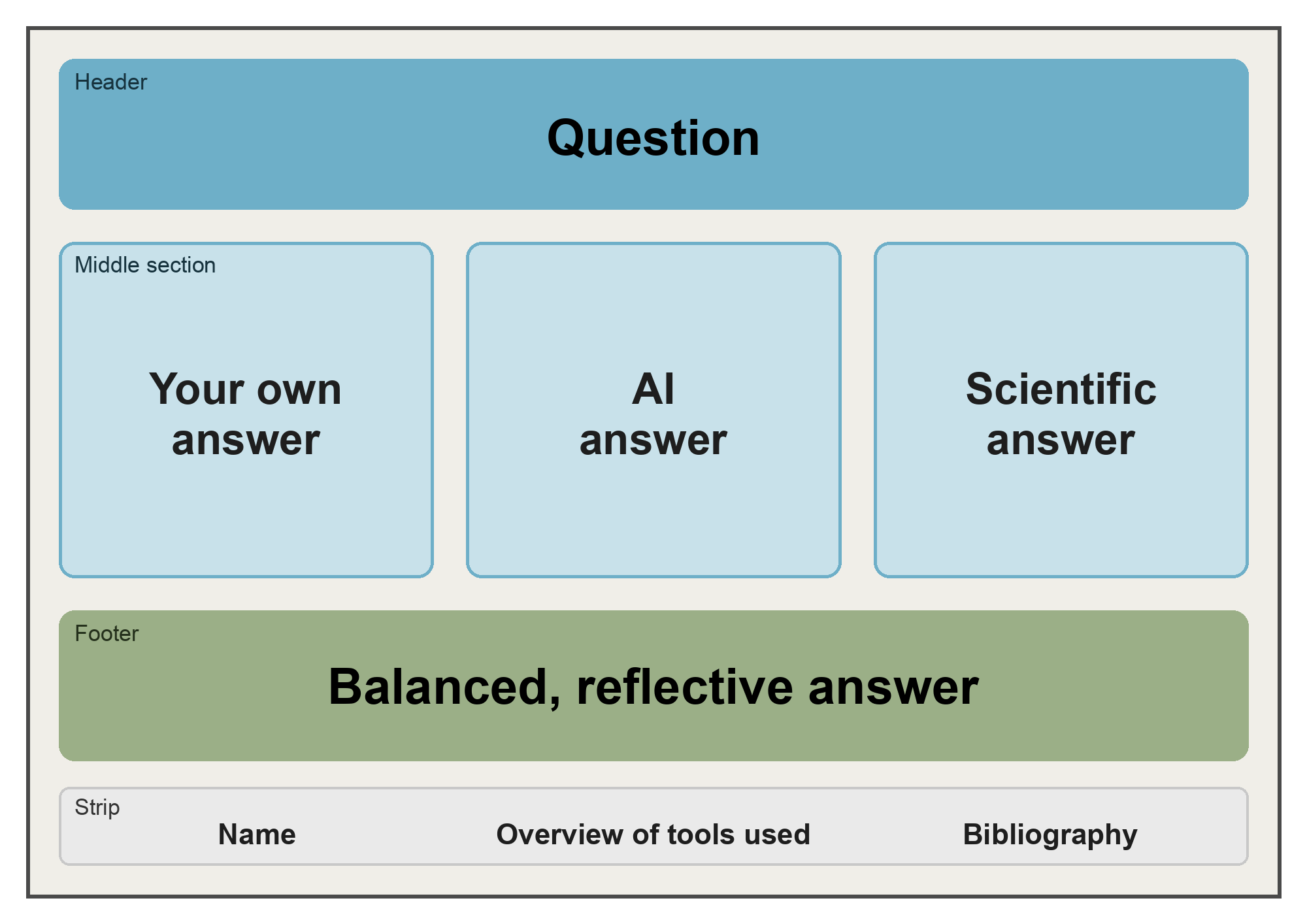
- Header: your question, word for word, as you chose it in FTS-02.
- Middle section: three columns side by side – your own answer as you wrote it in FTS-02, the answer of the artificial intelligence (AI) as a quotation and the scientific answer with short references.
- Footer: your balanced, reflective answer.
Below the footer, a narrow strip (German: Leiste) runs across the whole width of the poster. It carries your name, the bibliography in a smaller font and the overview of tools used (section 4.4).
The poster thus reads from top to bottom like the five steps of the didactic concept: from the question via the three answers to your balanced, reflective answer. The three columns stand side by side so that the reader can compare them at a glance. In FTS-04, all posters of a Sustainable Development Goal (SDG) appear one after the other on the projector; with the same layout, everybody finds the question, the three answers and the balanced, reflective answer in the same place on every poster.
The order of the three columns follows the order of the steps. Your own answer comes first, because you wrote it first; the AI answer comes second; the scientific answer comes third.
3.2 What belongs on your poster – and what does not
Space on a poster is scarce, so every element has to earn its place. The following table brings together what belongs on your poster and what does not:
| Belongs on your poster | Does not belong on your poster |
|---|---|
| Your question, word for word | Data and facts from the AI answer |
| Your own answer, unchanged | The AI answer as evidence for a statement |
| The AI answer as a quotation, with its long reference and the note that it is not evidence, and what you found when you checked its sources | The long reference of the AI answer anywhere other than at the quotation |
| The scientific answer, each statement with its short reference and page | Statements from sources without a short reference |
| Your balanced, reflective answer | Pictures without a source |
| Your name, the bibliography and the overview of tools used | Pictures and formatting that only decorate |
| Figures and pictures, if there is space – each with a caption and its source | The dummy text, the headings and the logo boxes of the template |
Most of the left column follows from the five steps and from the requirements of the exercise of phase 1, FTS-02.01. The right column has three sources. The first is the guide to Scientific Work: data and facts never come from AI output, and the quotation of an AI answer is never evidence (section 2.10). The second is the criterion of honesty: everything that is not your own carries its source (FTS-02, 4.5). The third is the advice on poster design: every element of a poster should serve its message (Erren and Bourne 2007, p. 778), and pictures that only decorate distract from the content (Gundogan et al. 2016, p. 69).
Pictures are welcome if they help the reader – a photo that shows what your question is about, or a figure from one of your sources that carries a finding. A picture that you have created with an AI tool may show a scene, but never data, a diagram or anything that serves as evidence. Chapter 4 shows how to cite each of them.
3.3 From the template to the PDF
An institution or a conference may prescribe a template (German: Vorlage) for posters, which can fix the logo, the colour scheme or the layout (ibid., p. 70). For your poster in this module, this is the English version of the HSBI template for scientific posters in A0 landscape format. You find it in the ILIAS course of this module. You cannot use it as it is – it has four columns instead of three, for example – so you adapt it to the fixed layout of your poster in PowerPoint.
The template is made for a doctoral project. It has the HSBI logo at the top, a title in one line with a subtitle, four columns with a placeholder for a picture and a caption above each text, and at the bottom a strip with an address, a name, two logo boxes and a line for the sources of photos. You adapt it like this:
- Header: Replace the title with your question, word for word. Use the line below for your SDG, for example ‘Sustainable Development Goal 9: Industry, innovation and infrastructure’.
- Middle section: Reduce the four columns to three and give them the headings ‘Your own answer’, ‘AI answer’ and ‘Scientific answer’. Delete the placeholders for pictures that you do not need.
- Footer: Insert a text box across the whole width below the three columns, with the heading ‘Balanced, reflective answer’.
- Strip at the bottom: Put ‘HSBI, University of Applied Sciences and Arts’ in place of the address, your name in place of the sample name, your bibliography in place of the line for the sources of photos and your overview of tools used in place of the logo boxes.
- Text: Replace all dummy text. Check that nothing of the template is left over.
- Pictures: Use pictures only where they add something to the content of your poster – no pictures for design or marketing only. Your poster does not have to look cool; it has to be correct and precise.
Then export the poster in the Portable Document Format (PDF) and open the PDF once more to check it. Upload it as a single PDF file in the exercise ‘Poster upload’ in the group of your SDG in ILIAS, by Wednesday 28 October 2026 at 23:55.
4 Whose words, whose picture? – Citing everything that is not your own
4.1 Statements from your sources
On your poster, only one column is entirely your own: your own answer. Everything else contains the work of others, and the rule for it is the same as in your term paper. Whenever you use texts, representations or ideas of others, directly or in essence, you refer to the source and mark the passage as a quotation – directly at the point where it appears (guide to Scientific Work, section 3.5).
There are two kinds of quotation:
- A direct quotation (German: direktes Zitat) reproduces the words of the source exactly. It stands in quotation marks.
- An indirect quotation (German: indirektes Zitat) reproduces the content in your own words. It carries the short reference as well, although it has no quotation marks.
On your poster, indirect quotations are the rule: you have little space, and in your own words you can state a finding concisely. Use a direct quotation where the exact wording matters, for example for a definition.
Each quotation carries its short reference in the name-year system: the surname of the author, the year and the page. You know the following example from FTS-02, 5.4, written as an indirect quotation:
An indirect quotation with its short reference – an example
According to Vogl et al. (2018, p. 736), producing one tonne of liquid steel by hydrogen direct reduction takes 3.48 MWh of electricity, most of it for making the hydrogen by electrolysis.
For each short reference, the bibliography on your poster contains the long reference (guide to Scientific Work, section 2.9). Zotero, which you use for your source package, can create both for you. And because references are wordy and take up space, cite only the key references on a poster (Gundogan et al. 2016, p. 70).
4.2 The AI answer: a quotation, never evidence
The answer of the artificial intelligence (AI) is the only text on your poster that you quote although it is not a source. The guide to Scientific Work does not permit quoting AI output in a paper, with one exception: the scientific examination of such output – and that is what you do in step 3 (section 2.10). You quote the AI answer verbatim in quotation marks or paraphrased, and in both cases, it carries its long reference (German: Langbeleg) directly at the quotation: the product, the access source, the model and the mode and the date of your query, followed by the note that the quotation is not evidence. It never gets a short reference, and its long reference stands nowhere else – not in the bibliography.
For our example, the question ‘Does hydrogen make steel production climate-neutral?’ was put word for word to Claude. Here are two passages from the last section of its answer; the second mentions the Hydrogen Breakthrough Ironmaking Technology (HYBRIT) project:
Claude
‘With green hydrogen and renewable electricity, emissions can drop sharply. Commonly cited reductions are in the range of 80 to over 90 % compared with the blast furnace route, depending on assumptions. That is “near-zero”, not strictly climate-neutral. […] Pilot projects show the technology works, for example HYBRIT in Sweden, which delivered its first fossil-free steel in 2021.’ (Claude, Claude app for macOS, Claude Opus 5.5 with effort xhigh, queried 2026-10-16) – AI output, quoted as an example – not evidence.
When I checked the answer like a reviewer, I found the following. The answer names no sources at all, so there was nothing to look up. Some of its statements agree with the scientific sources of our example – for example, that steel still causes emissions with renewable electricity (Vogl et al. 2018, p. 740). Others are confirmed only in part or not at all. Take the reduction of ‘80 to over 90 %’: neither source gives such a range, and nothing in them supports its lower end of 80 %. Its upper end, however, is consistent with Vogl et al. (2018, p. 741), who put the emissions that remain from carbon, lime and electrodes at 2.8 % of those of the blast furnace route – that is, a reduction of over 90 %, provided that the electricity is free of emissions. And the second passage says that the HYBRIT project delivered its first fossil-free steel in 2021, which a case study from 2019 cannot confirm. On the poster, the AI column reports this result next to the quotation.
4.3 Figures, tables and pictures
For figures, tables and pictures, the guide to Scientific Work sets out the same rules for your poster as for your term paper (sections 3.6 and 3.7). Each figure has a caption (German: Unterschrift) below it: the word ‘Figure’, its number, a colon and a concise description, and on the next line its source. A table has its heading above it, in the same form.
How you cite a figure from a source depends on what you have done with it:
| What you have done | How you cite it |
|---|---|
| Copied the figure unchanged | as a direct (image) quotation: (author year, p. page) |
| Used its content or design and revised it | with ‘cf.’ at the beginning: (cf. author year, p. page) |
| Drawn your own figure based on an existing one | ‘(based on source)’ after the description |
| Combined data from several sources | all sources |
A photo from the internet is cited in the same way: the short reference in the caption, the long reference in the bibliography. Choose photos with good resolution, so that nothing blurs (Gundogan et al. 2016, p. 70).
A picture generated by an AI tool is a special case. The guide to Scientific Work expressly prohibits images and figures taken directly from AI without checking their source and content (section 2.10). On your poster, an AI picture may therefore only show a scene that illustrates your topic – never data, a diagram or anything that serves as evidence – and you check what it shows. Its caption names the tool, for example ‘Image generated with <product> (<model>)’, and the tool appears in your overview of tools used. This script does the same: every AI picture in it carries the line ‘Image by Qwen-Image 2.1’, and Qwen-Image 2.1 appears in the overview of tools used at the end.
4.4 Bibliography and overview of tools used on your poster
Your bibliography and your overview of tools used go into the narrow strip at the bottom of your poster, next to your name.
The bibliography (German: Literaturverzeichnis) contains the long references for all short references on your poster, including those in the captions of figures and pictures. You arrange them alphabetically by the surnames of the authors and by year, as the guide to Scientific Work specifies for the name-year system (section 2.9). A long reference of the AI answer does not belong in it. As Gundogan et al. (2016, p. 70) recommend, use a smaller font than for the main text, because references take up a lot of space.
The overview of tools used (German: Übersicht verwendeter Hilfsmittel) names every AI tool that has helped you as a tool – for example in checking the draft of your outline or in correcting your spelling (guide to Scientific Work, section 2.10), or in generating a picture. It has four columns:
| Product name | Access source | Software functions used | Scope of use |
|---|---|---|---|
| name of the tool | address | model, mode | purpose |
The AI service that you questioned in step 3 also appears in this table, with the examination of its answer as the scope of use – as a tool, not as a reference: its answer is never evidence and does not belong in the bibliography.
4.5 The example poster
The example poster brings together everything from this lesson for our example question, ‘Does hydrogen make steel production climate-neutral?’
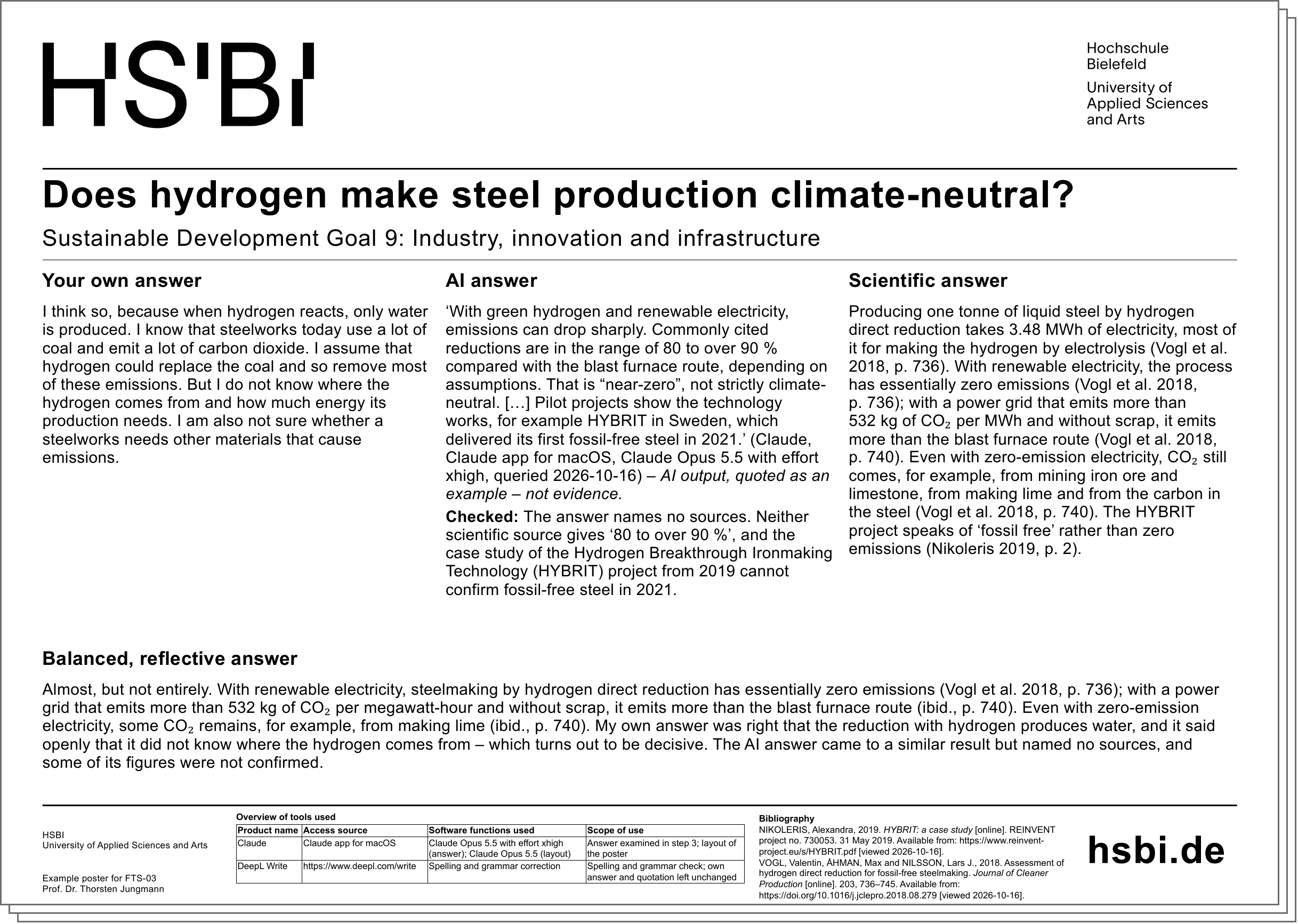
- Header: the question, word for word, and below it the Sustainable Development Goal (SDG) to which it belongs, SDG 9, industry, innovation and infrastructure.
- Your own answer: the example of your own answer from FTS-02, 5.2, unchanged.
- AI answer: the two passages from the answer of Claude in section 4.2, with its long reference and the note, and below it the result of the check: no sources named, some figures not confirmed by the sources.
- Scientific answer: the findings of Vogl et al. (2018) and Nikoleris (2019), each statement as an indirect quotation with its short reference and page.
- Footer: the balanced, reflective answer from section 1.3.
- Strip at the bottom: ‘HSBI, University of Applied Sciences and Arts’, my name, the two long references of the bibliography and the overview of tools used: Claude, whose answer is examined and which laid out the poster, and DeepL Write, which checked the spelling and grammar of the texts and left my own answer and the quotation unchanged.
Look at the example poster from a distance first, as a reader passing by would: do you see the question and the balanced, reflective answer at a glance? Then look at the details: where does each statement come from, and how can you tell? Use the example poster as a model for the structure – not for the content. Your question, your three answers and your balanced, reflective answer come from your own work.
5 Your poster in a nutshell – The elevator talk
5.1 What your elevator talk contains
The elevator talk (German: Elevator Talk) – Caromile et al. call it the elevator pitch – is named after the short ride in an elevator: researchers use it to convey a complex idea in a few words (Caromile et al. 2024, p. 1). In FTS-04, you give your elevator talk while your poster is shown on the projector, grouped by Sustainable Development Goal (SDG); each talk takes 60 to 90 seconds.

Image by Qwen-Image 2.1
Your elevator talk contains five parts, in this order:
- Your question: what you wanted to know.
- Your own answer: what you thought before you consulted any source.
- The scientific answer: what the scientific sources say.
- The answer of the artificial intelligence (AI): how it fits in.
- Your insight: your balanced, reflective answer and what you take away from the exercise.
The order follows your poster from top to bottom, except for the AI answer: in your talk, it comes after the scientific answer, because you can only say how it fits in once your listeners know what the sources say.
Caromile et al. (2024, p. 4) describe three main elements of such a talk: an introduction, the research and a conclusion with a follow-up. In your elevator talk, the question is the introduction, your own answer, the scientific answer and the AI answer are the research, and your insight is the conclusion.
5.2 From the poster to the spoken word
Your elevator talk is not a reading of your poster. While presenting, you guide your listeners through your poster, but you do not read it off (Gundogan et al. 2016, p. 71). Three pieces of advice help you to turn your poster into spoken words:
- Short: one or two sentences for each part, concentrated on the key concepts (Caromile et al. 2024, p. 5).
- Simple: plain language without jargon, so that listeners from outside your field can follow (ibid., pp. 3, 5).
- Practised: rehearse your talk beforehand and ask others for feedback (ibid., p. 6).
Comprehensibility is the criterion that counts here: everybody in the room should understand your question and your balanced, reflective answer (FTS-02, 4.12). In a talk, you name your sources in words, for example ‘a study by Vogl and colleagues from 2018 shows …’.
An elevator talk – an example
‘My question was: does hydrogen make steel production climate-neutral? Before I read anything, I thought so, because only water is produced. A study by Vogl and colleagues from 2018 shows that with renewable electricity, the process has essentially zero emissions, but carbon dioxide still comes, for example, from mining the ore, from making lime and from the carbon in the steel. The AI service I asked came to a similar result, but it named no sources, and some of its figures were not confirmed by the scientific sources. So my answer today is: almost, but not entirely. What I take away: how much hydrogen helps the climate depends above all on where the electricity comes from.’
In FTS-04, you will hear many elevator talks one after the other. The clearer yours is, the easier it is for everybody to remember your question – and your balanced, reflective answer.
6 What have you learnt today? – Summary and answers to the guiding questions
6.1 The building blocks of knowledge
- Weighing up: claim, evidence, conclusion: What your balanced, reflective answer says about your question are claims that rest on evidence from a scientific source, and the conclusion follows from this evidence – no more and no less.
- The balanced, reflective answer: It answers your question in its first sentence, names the conditions and limits with their short references and reflects on how your own answer and the answer of the artificial intelligence (AI) compare with what the sources say.
- Posters in science: Posters are one of the main ways of presenting work at conferences and an important element of a scientific career; more and more conferences show them electronically.
- What makes a good scientific poster: a snapshot that starts a conversation, centred on a decisive question, with little text, white space, a clear order and legible type; the 13 criteria apply to it as to every piece of scientific work.
- Layout, content and template of your poster: the question in the header, the three answers in the middle section, the balanced, reflective answer in the footer and a narrow strip with your name, your bibliography and your overview of tools used, adapted from the HSBI template in A0 and exported in the Portable Document Format (PDF).
- Citing statements, AI output, figures and pictures: direct and indirect quotations with their short references; the AI answer as a quotation with its long reference and the note, never as evidence; figures and pictures with a caption and their source, AI pictures only as scenes.
- Bibliography and overview of tools used on the poster: the long references in a smaller font in the strip at the bottom, and in the overview of tools used the AI tools that helped you, including the AI service whose answer you examine – as a tool, not as a reference.
- The structure of the elevator talk: your question, your own answer, the scientific answer, the AI answer and your insight – short, simple and practised.
6.2 Answers to the guiding questions
How do you weigh up your three answers into a balanced, reflective answer?
You lay your own answer, the AI answer and the scientific answer side by side and ask where they agree, where they contradict each other and why. You test your own answer against all the evidence, including the evidence that contradicts it, and you never use the AI answer as evidence – at most, real sources that it names can point you to evidence once you have checked them yourself. Your balanced, reflective answer makes claims, each supported by evidence from a scientific source, draws a conclusion that says exactly as much as the evidence carries and reflects on what you have learnt.
What makes a good scientific poster, and what belongs on yours?
A good scientific poster is a snapshot that starts a conversation: it focuses on a decisive question, uses few words and leaves white space, and every element of it serves its message. Your question, your three answers, your balanced, reflective answer, your name, your bibliography and your overview of tools used belong on your poster – and figures or pictures if there is space and they add to the content, each with its source.
How do you cite everything on your poster that does not come from you?
Every statement from a scientific source carries its short reference with the page, and the bibliography in the strip at the bottom contains its long reference. The AI answer stands as a quotation with its long reference and the note that it is not evidence. Figures and pictures carry a caption with their source, and the overview of tools used lists the AI tools that have helped you, including the AI service whose answer you examine.
How do you present your poster in an elevator talk?
You present your question, your own answer, what the scientific sources say, how the AI answer fits in and the insight you take away – one or two sentences for each part, in plain language and without reading your poster off. You practise your talk beforehand and ask others for feedback.
Bibliography
- CAROMILE, Leslie A., JHA, Ankita, GARDINER, Jaye C., DILEK, Ozlem, OHI, Ryoma and LIGON, Lee, 2024. How to construct and deliver an elevator pitch: a formula for the research scientist. BMC Proceedings [online]. 18(Suppl 1), 27. Available from: https://doi.org/10.1186/s12919-024-00312-2 [viewed 2026-10-16].
- ERREN, Thomas C. and BOURNE, Philip E., 2007. Ten simple rules for a good poster presentation. PLoS Computational Biology [online]. 3(5), e102, 777–778. Available from: https://doi.org/10.1371/journal.pcbi.0030102 [viewed 2026-10-16].
- GUNDOGAN, Buket, KOSHY, Kiron, KURAR, Langhit and WHITEHURST, Katharine, 2016. How to make an academic poster. Annals of Medicine and Surgery [online]. 11, 69–71. Available from: https://doi.org/10.1016/j.amsu.2016.09.001 [viewed 2026-10-16].
- JUNGMANN, Thorsten, 2025. Abschlussarbeiten aus Prüfersicht: Bachelor-, Master- oder Doktorarbeit schreiben und selbst bewerten – Leitfaden zur Bestnote [Final theses from an examiner’s perspective]. Herne: Prof. Dr. Thorsten Jungmann. ISBN 978-3-911872-02-7.
- NIKOLERIS, Alexandra, 2019. HYBRIT: a case study [online]. REINVENT project no. 730053. 31 May 2019. Available from: https://www.reinvent-project.eu/s/HYBRIT.pdf [viewed 2026-10-16].
- VOGL, Valentin, ÅHMAN, Max and NILSSON, Lars J., 2018. Assessment of hydrogen direct reduction for fossil-free steelmaking. Journal of Cleaner Production [online]. 203, 736–745. Available from: https://doi.org/10.1016/j.jclepro.2018.08.279 [viewed 2026-10-16].
Overview of tools used
In creating this script, AI-supported software tools were used to generate and revise text and images according to my specifications:
| Product name | Access source | Software functions used | Scope of use |
|---|---|---|---|
| Perplexity | https://www.perplexity.ai | Search | Research |
| Gemini | https://gemini.google.com | Search | Research |
| Connected Papers | https://www.connectedpapers.com | Graphs of related papers | Research |
| Claude | https://claude.ai | Claude Opus and Claude Fable | Consistency checking, corrections, text revision and translation |
| Qwen-Image 2.1 | Installation on a server of the author | Text-to-image generation | Photorealistic images of everyday scenes |
| Claude | Claude app for macOS | Claude Opus 5.5 with effort xhigh | Answer to the example question, examined in 4.2 |
| DeepL Write | https://www.deepl.com/write | Spelling and grammar correction | Check of the texts of the example poster in 4.5 |
Exercises for this lesson
In the exercise time of this session, you weigh up your three answers and write your balanced, reflective answer. Then you adapt the poster template, insert your question, your three answers and your balanced, reflective answer, add the sources and check every element that does not come from you. Upload your poster as a file in the Portable Document Format (PDF) in ILIAS by Wednesday 28 October 2026 at 23:55, and practise your elevator talk before FTS-04. The exercise of phase 1 describes everything you do in phase 1:
Exercise FTS-02.01 – Poster on your Sustainable Development Goal
Four exercises help you on the way: you practise weighing up and citing on our example question, build your poster from the template up to the upload in ILIAS and prepare your elevator talk.
Exercise FTS-03.01 – Weighing up the answers to the hydrogen question
Exercise FTS-03.02 – Citing on a poster
Exercise FTS-03.03 – Your poster from the template to ILIAS
Exercise FTS-03.04 – Preparing your elevator talk
Slides for this lesson
The slides of this lesson as PDF: Slides FTS-03
⏭️ Continue with: FTS-04 Elevator talks on the SDGs 🔗