Prof. Dr. Thorsten Jungmann (last updated 2026-10-20)
Overview of this lesson
What is this lesson about? – The guiding questions:
- How do the elevator talks in this session work?
- How do you make sure that everybody understands your question and your balanced, reflective answer?
- What have you learnt in phase 1, and what will you do differently in phase 2?
- What awaits you in phase 2?
What will you be able to do at the end of this lesson? – The intended learning outcomes:
- You explain your question and your balanced, reflective answer comprehensibly in your elevator talk.
- You reflect on your work in phase 1: what you have learnt with the five steps and what you will do differently.
- You know how phase 2 works and what is expected of you.
What will you know at the end of this lesson? – The building blocks of knowledge:
- Comprehensibility in your elevator talk
- How the elevator talks run
- Phase 1 at a glance
- Questions for reflection
- Phase 2 step by step
- What is new in phase 2
How is the content organized? – The structure:
Review of the previous lesson
In the previous lesson, you weighed up your three answers and designed your poster.
- Weighing up means making claims that rest on evidence and drawing a conclusion that says no more than the evidence carries.
- Your balanced, reflective answer answers your question, names its conditions and limits and compares your own answer and the answer of the artificial intelligence (AI) with what the sources say.
- A good scientific poster is a snapshot around a decisive question; yours follows the fixed layout, adapted from the HSBI template.
- Everything on your poster that does not come from you carries its source, and the AI answer stands as a quotation with its long reference and the note that it is not evidence.
- Your elevator talk has five parts: your question, your own answer, the scientific answer, the AI answer and your insight.
Today, you give your elevator talk – and afterwards, we look back on phase 1 and ahead to phase 2.
1 Your poster on stage – The elevator talks
1.1 Making yourself understood
With your elevator talk today, phase 1 comes to an end. Of the 13 criteria of scientific work, one is in focus: comprehensibility (FTS-02, 4.12). It asks for clear and precise language and an accessible presentation, and complex matters should be explained so that colleagues in your field can follow them without losing depth (Jungmann 2025, p. 22). Your colleagues today are your fellow students. Most of them have worked on other Sustainable Development Goals (SDGs) and have not read your sources – and yet everybody in the room should understand your question and your balanced, reflective answer.
You already know from FTS-03, 5.1 what makes a talk easy to follow. It has five parts in a fixed order: your question, your own answer, the scientific answer, the answer of the artificial intelligence (AI) and your insight. While you speak, your poster is on the projector. Use it to guide your listeners through your work, but do not read it off (Gundogan et al. 2016, p. 71).
Three more things help your listeners. The first two are pieces of advice from Caromile et al., who call such a talk an elevator pitch:
- One or two sentences for each part, concentrated on the key concepts (Caromile et al. 2024, p. 5).
- Simple language without jargon, so that listeners from outside your field can follow you (ibid., pp. 3, 5).
- Sources in words, for example ‘a study by Vogl and colleagues from 2018 shows …’, as in the example in FTS-03, 5.2.
1.2 How the elevator talks run
The elevator talks run grouped by SDG. The members of one SDG group give their talks one after the other; then the next group follows. While you speak, I show your poster on the projector, and each talk takes 60 to 90 seconds. Because all posters share the same layout, everybody finds the question, the three answers and the balanced, reflective answer in the same place on every poster (FTS-03, 3.1).

Image by Qwen-Image 2.1
For the length of your talk, the room belongs to you: as in the picture, everybody else listens. After the deadline for the upload, I put all posters into a folder in the ILIAS course that everybody can open, so you can read the posters of the others again and see how your fellow students have answered their questions (FTS-01, 3.4).
After the last elevator talk, we look back on phase 1 together – and ahead to phase 2.
2 Five steps behind you – Looking back on phase 1
2.1 Phase 1 at a glance
With the last elevator talk, phase 1 is complete. In three sessions and the days in between, you have taken all five steps of the didactic concept, from your question to your balanced, reflective answer:
| When | What you did | Step |
|---|---|---|
| FTS-02 on 16 October | You signed up for your Sustainable Development Goal (SDG), chose your question and wrote down your own answer. | 1, 2 |
| Until 23 October | You put your question to the artificial intelligence (AI) service of your SDG and checked the sources it names. You read the texts of your source package and noted where each statement comes from. | 3, 4 |
| FTS-03 on 23 October | You weighed up the three answers into your balanced, reflective answer and designed your poster. | 5 |
| Wednesday 28 October | You uploaded your poster in ILIAS. | – |
| FTS-04 on 30 October | You presented your poster in your elevator talk. | – |
The same five steps carry you through phase 2, and in phase 3, you apply them on your own in your term paper (FTS-01, 5.1). Your poster, too, remains useful: it is a resource for your term paper (FTS-01, 3.4), and in phase 3, you can link your term paper to the SDG of your poster (FTS-02, 6.1). So keep your poster and your notes.
2.2 Questions for reflection
Looking back on your own work is part of scientific work. Reflexivity, one of the 13 criteria, means critical self-reflection on your own position in the research process, and being able to question your own work critically is a central element of scientific maturity (Jungmann 2025, p. 21). You know the criterion from FTS-02, 4.11: your own answer from step 2 shows you where you started from.
Today, you apply it to the whole of phase 1. You look back on your work and ask yourself what you have learnt and what you will do differently next time – this is reflection (German: Reflexion). I put the following questions to you in the session; there is nothing to upload.
Questions for reflection
- What is the most important thing you have learnt in phase 1?
- How does your balanced, reflective answer differ from your own answer?
- What did checking the AI answer show you?
- Which step was the most difficult for you, and why?
- What went well, and what will you do differently in phase 2?
- Which questions remain open?

Image by Qwen-Image 2.1
Take a moment for it, like the student in the picture. The second question can be answered for our example question, too:
Looking back on the hydrogen question – an example
How does the balanced, reflective answer to our example question differ from the example of your own answer? The example in FTS-02, 5.2 answered ‘I think so’, because only water is produced when hydrogen reacts, and it admitted that it did not know where the hydrogen comes from. It was right about the water: hydrogen reduces the iron ore to iron, and water is formed (Vogl et al. 2018, p. 738). The open point, however, turned out to be decisive. Making the hydrogen takes most of the 3.48 MWh of electricity that hydrogen direct reduction needs for one tonne of liquid steel (ibid., p. 736). As Vogl et al. assume that the process runs on electricity alone, its emissions depend mainly on how much carbon dioxide the power grid emits per megawatt-hour (ibid., p. 740). You find the complete balanced, reflective answer in FTS-03, 1.3.
3 Twenty trends ahead – Looking ahead to phase 2
3.1 Phase 2 step by step
In phase 2, from FTS-05 to FTS-07, we look ahead at 20 future trends that are changing the work of mechatronics engineers and industrial engineers. Nine of them are technological; eleven are social (FTS-01, 5.4). The 20 pictures, one per trend, give you a first impression:
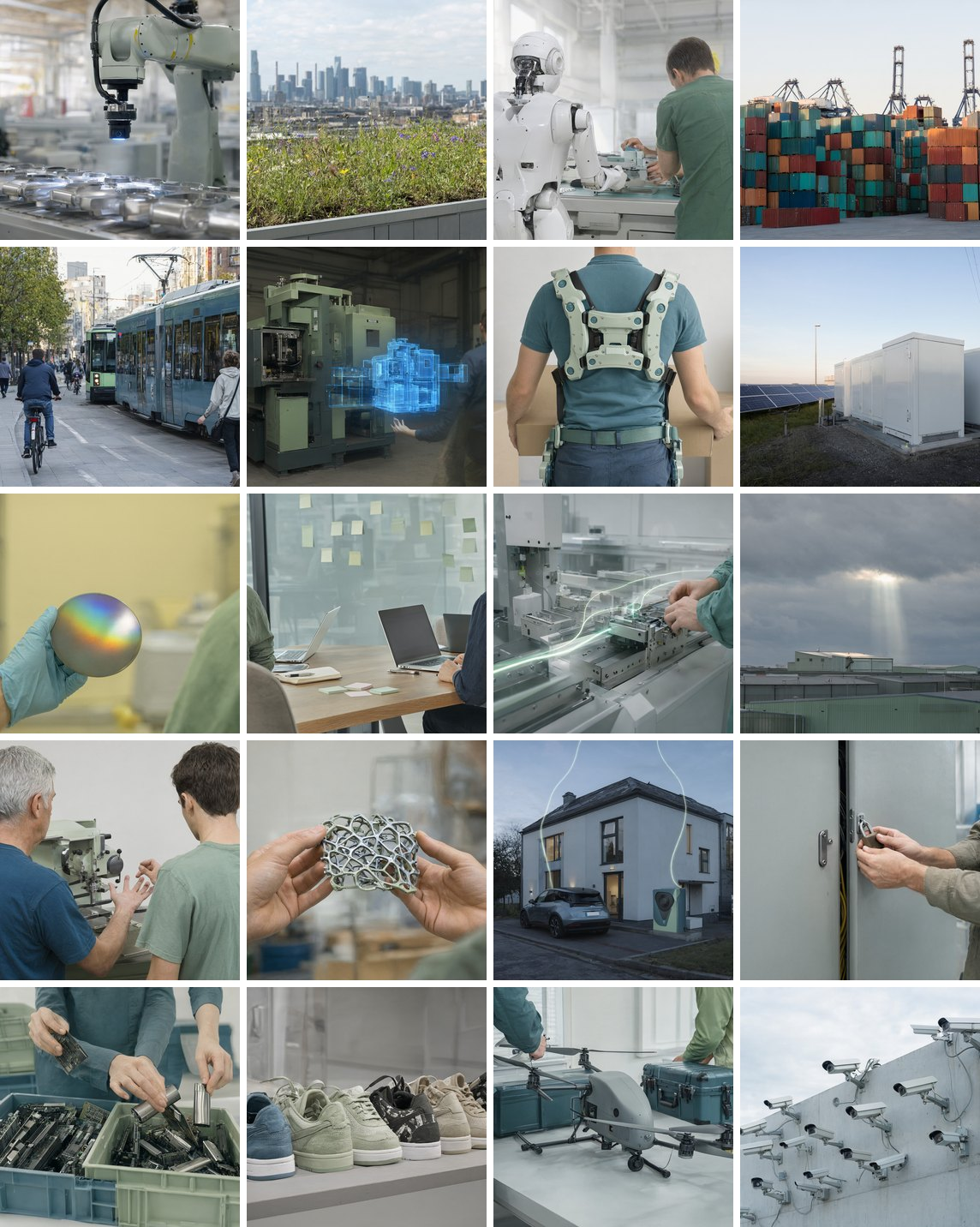
Images by Qwen 2.1
Phase 2 follows the same pattern as phase 1:
- FTS-05 on 6 November, ‘Introduction, Grouping up & First Step’: I introduce the future trends, and you sign up for one of them. Each trend has four places, set up as groups in ILIAS; two of the four share a source package. You work on a question about your trend and write down your own answer – before you consult any source.
- Until FTS-06: steps 3 and 4 on your own, with the artificial intelligence (AI) service of your trend and your source package.
- FTS-06 on 13 November, ‘Elaboration & Poster design’: you exchange your answers in your trend group; then you weigh them up on your own and complete your poster.
- By Wednesday 18 November 2026 at 23:55: you upload your poster in ILIAS.
- FTS-07 on 20 November, ‘Elevator talk’: you present your poster in an elevator talk.
The five steps and the layout of your poster stay the same, so you can use again what you have practised in phase 1.
3.2 What is new in phase 2
The topic is new, and so is the focus of scientific work: phase 2 is about sources (FTS-01, 5.4).
- In FTS-05, you learn to evaluate sources: which types of sources there are, how to recognize publications funded by industry and the interests behind them, and what a study has examined and how. You also put the same question to the AI twice and compare the two answers.
- In FTS-06, you practise presenting an opposing position fairly, giving and receiving feedback, paraphrasing and creating a bibliography with Zotero.
What is also new is the exchange in your trend group. In phase 1, you took all steps on your own; in phase 2, you talk about your answers with the other members of your trend group before you weigh them up.
4 What have you learnt today? – Summary and answers to the guiding questions
4.1 The building blocks of knowledge
- Comprehensibility in your elevator talk: everybody in the room understands your question and your balanced, reflective answer – five parts in their order, one or two sentences each, simple language without jargon, sources named in words and your poster as a guide, not a script.
- How the elevator talks run: grouped by Sustainable Development Goal (SDG), one after the other, with your poster on the projector and 60 to 90 seconds for each talk; after the deadline, all posters are in a folder in the ILIAS course.
- Phase 1 at a glance: the five steps once from beginning to end, from your question in FTS-02 to your elevator talk; your poster as a resource for your term paper.
- Questions for reflection: what you have learnt, how your balanced, reflective answer differs from your own answer, what checking the answer of the artificial intelligence (AI) showed you, what went well and what you will do differently in phase 2.
- Phase 2 step by step: one future trend per person, question and your own answer in FTS-05, AI service and source package until FTS-06, exchange in the trend group and poster in FTS-06, upload by Wednesday 18 November 2026 at 23:55, elevator talks in FTS-07.
- What is new in phase 2: evaluating sources, the same question put to the AI twice, presenting an opposing position fairly, feedback, paraphrasing and a bibliography with Zotero.
4.2 Answers to the guiding questions
How do the elevator talks in this session work?
Grouped by SDG, everybody gives an elevator talk of 60 to 90 seconds, one after the other, while I show the poster on the projector. After the deadline for the upload, all posters are in a folder in the ILIAS course that everybody can open.
How do you make sure that everybody understands your question and your balanced, reflective answer?
You follow the five parts in their order – your question, your own answer, the scientific answer, the AI answer and your insight – with one or two sentences for each, in simple language without jargon. You name your sources in words and guide your listeners through your poster instead of reading it off.
What have you learnt in phase 1, and what will you do differently in phase 2?
That is for you to answer – and the questions for reflection help you: what you have learnt, how your balanced, reflective answer differs from your own answer, what checking the AI answer showed you, which step was the most difficult and why, what went well and what you will do differently, and which questions remain open.
What awaits you in phase 2?
A future trend of your own and the same five steps: your question and your own answer in FTS-05, your AI service and your source package until FTS-06, the exchange in your trend group and your poster in FTS-06, the upload by Wednesday 18 November 2026 at 23:55 and your elevator talk in FTS-07. As for scientific work, phase 2 is about sources – how to evaluate them – and about presenting an opposing position fairly, paraphrasing and creating a bibliography with Zotero.
Bibliography
- CAROMILE, Leslie A., JHA, Ankita, GARDINER, Jaye C., DILEK, Ozlem, OHI, Ryoma and LIGON, Lee, 2024. How to construct and deliver an elevator pitch: a formula for the research scientist. BMC Proceedings [online]. 18(Suppl 1), 27. Available from: https://doi.org/10.1186/s12919-024-00312-2 [viewed 2026-10-20].
- GUNDOGAN, Buket, KOSHY, Kiron, KURAR, Langhit and WHITEHURST, Katharine, 2016. How to make an academic poster. Annals of Medicine and Surgery [online]. 11, 69–71. Available from: https://doi.org/10.1016/j.amsu.2016.09.001 [viewed 2026-10-20].
- JUNGMANN, Thorsten, 2025. Abschlussarbeiten aus Prüfersicht: Bachelor-, Master- oder Doktorarbeit schreiben und selbst bewerten – Leitfaden zur Bestnote [Final theses from an examiner’s perspective]. Herne: Prof. Dr. Thorsten Jungmann. ISBN 978-3-911872-02-7.
- VOGL, Valentin, ÅHMAN, Max and NILSSON, Lars J., 2018. Assessment of hydrogen direct reduction for fossil-free steelmaking. Journal of Cleaner Production [online]. 203, 736–745. Available from: https://doi.org/10.1016/j.jclepro.2018.08.279 [viewed 2026-10-20].
Overview of tools used
In creating this script, AI-supported software tools were used to generate and revise text and images according to my specifications:
| Product name | Access source | Software functions used | Scope of use |
|---|---|---|---|
| Perplexity | https://www.perplexity.ai | Search | Research |
| Gemini | https://gemini.google.com | Search | Research |
| Connected Papers | https://www.connectedpapers.com | Graphs of related papers | Research |
| Claude | https://claude.ai | Claude Opus and Claude Fable | Consistency checking, corrections, text revision and translation |
| Qwen-Image 2.1 | Installation on a server of the author | Text-to-image generation | Photorealistic images of everyday scenes |
Exercises for this lesson
In this session, the elevator talks take the place of the exercise time. The exercise of phase 1 describes everything you have done in phase 1:
Exercise FTS-02.01 – Poster on your Sustainable Development Goal
Slides for this lesson
The slides of this lesson as PDF: Slides FTS-04
⏭️ Continue with: FTS-05 Future trends 🔗