Prof. Dr. Thorsten Jungmann (last updated 2026-11-03)
Overview of this lesson
What is this lesson about? – The guiding questions:
- What awaits you in this module, and how will you show at the end what you can do?
- How do you arrive at a well-founded answer to a question such as ‘Does hydrogen make steel production climate-neutral?’
- Which systems and tools do you need for your studies, and where do you find them?
What will you be able to do at the end of this lesson? – The intended learning outcomes:
- You know how the module is organized and what is expected of you.
- You find the systems of the university and the tools that you need for this module.
- You understand the didactic concept of five steps in three phases and know what to do in all of them.
- You name the topics of the module and assign them to the three phases.
What will you know at the end of this lesson? – The building blocks of knowledge:
- Studying at university
- Communication in the module
- Systems and tools for your studies
- Structure and organization of the module
- The didactic concept in five steps
- Form of assessment
- Phase 1: Sustainable Development Goals
- Phase 2: Future trends
- Phase 3: Companies in a VUCA and BANI world
How is the content organized? – The structure:
- 1 Studying successfully – Nothing comes from nothing!
- 2 Ready to start? – Systems and tools for your studies
- 3 How do I teach? – Three phases, one concept
- 4 The examination – your stage
- 5 What awaits you? – The semester at a glance
- 6 What have you learnt today? – Summary and answers to the guiding questions
1 Studying successfully – Nothing comes from nothing!
1.1 What does ‘studying’ mean?
Welcome to Future Technologies and Sustainability!
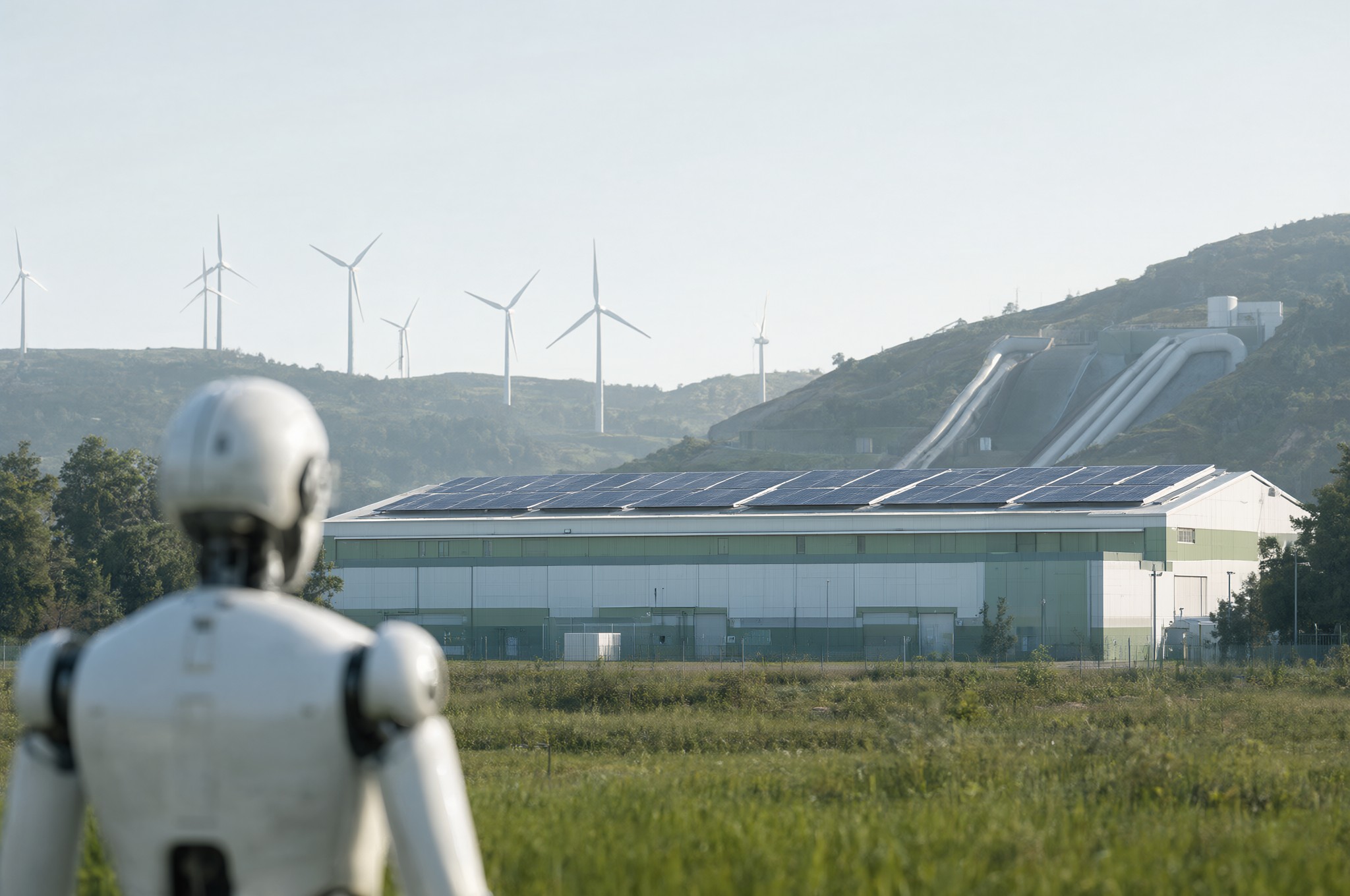
Image by Qwen-Image 2.1
The picture shows where the two halves of the module’s name meet: future technologies, from a humanoid robot to wind turbines and a pumped-storage power station, and an industry that depends on its environment. In this module, you look at both with the eyes of a scientist for the first time.
For most of you, this is one of the very first modules of your studies, and many of you have only just arrived in Germany and at HSBI. That is why I would like to begin this module with the person who decides whether your studies succeed: you.
What does ‘studying’ mean?
Studere (Latin): to strive for something, to pursue something, to devote oneself intensively to a matter on one’s own initiative, to engage in something scientifically, to learn.
At university, your success depends less on what is taught than on what you do with it.
Where does success come from? From your behaviour during your studies!
- Take an active part in the sessions: listen attentively, take notes, ask questions, discuss and join in the exercises.
- Prepare for each session and follow it up.
- Practise what you learn – in this module, above all the five steps of the didactic concept.
- Learn, work and sometimes celebrate together as a group.
- Keep the goals in sight from the very beginning.
Of all these points, I would like to emphasize one: take notes. Whoever writes down in their own words what they have just heard has already begun to work with it – and finds it again weeks later, when the term paper is due.
At the end of this path stands your degree – and the day on which you throw your cap into the air together with your fellow students. Until then, studying means more than collecting credits: you learn to think and to work in an academic way.

Image by Qwen-Image 2.1
Every lesson in this script helps you keep the goals in sight. It begins with an overview of the guiding questions, the intended learning outcomes and the building blocks of knowledge, and its main part ends with a summary and the answers to the guiding questions. Read the overview before the session, and check afterwards whether you can answer the guiding questions yourself.
NOW:
Set up a notebook for this module and take notes, for example in the Cornell note-taking format.
1.2 Rules for our sessions
We are a large group in one room. We can only work well together if everybody keeps to a few rules:
- Be on time. Please arrive punctually, so that the session can begin with everybody.
- Ask. If you do not understand something, ask immediately. Any question is allowed, and most questions are appreciated: very often, others in the room have the same question.
- Prepare and follow up. Read the lesson in this script before the session, and go through your notes afterwards.
- No photos. Do not take photos during the sessions, not even of the screen or the board.
- No recordings. Do not make audio or video recordings of the sessions, not even for a transcription.
You do not need photos or recordings anyway. This script contains the complete content of every session, and the slides of each lesson are available in the Portable Document Format (PDF) at the end of the lesson. What the script cannot give you is your own thinking during the session – and that is what your notes are for.
1.3 How to reach me
The quickest way to get an answer is to ask in the session: before, during and after the lecture and in the exercise time. Often, your fellow students benefit from the answer as well.
For everything else, there are these channels:
- The Q&A forum in the ILIAS course: for questions about the content and the organization of the module. Please use it first: everybody can read the answer, and nobody has to ask the same question twice.
- E-mail: thorsten.jungmann@hsbi.de
- Consultation hours (German: Sprechstunde): I hold them online via Zoom; you book an appointment in the ILIAS course.
- Telephone: 0521 106-70367
Whichever channel you choose, please be professional, give complete information and use clear language, without text ‘between the lines’. I can only answer what I understand.
1.4 E-mail communication – a negative example
In a company, an e-mail is often the first impression you make on colleagues, customers or your future boss. Communication in companies is part of this module, and it starts with an e-mail to your lecturer. Let us begin with an example of how not to do it:
Negative example
Hello,
I’d like to know what group I am in and when the lecture starts.
Kind regards
Steve
Who is Steve? Which degree programme, which semester, which module, which group? Before I can answer, I have to ask for the missing details – and the answer is probably in ILIAS anyway.
1.5 E-mail communication – a positive example
This is how it works better:
Positive example
Dear Prof. Jungmann,
My name is <first name> <surname>, and I am studying Mechatronics and Automation in my first semester. I am writing to you regarding the lecture in the module Future Technologies and Sustainability that I am taking with you this semester.
Unfortunately, I was unable to find an answer to my question in either the ILIAS course or the lecture materials, and I hope you can help me: <question or request>
Kind regards
<first name> <surname> (pronouns)
This e-mail works because it answers all questions before they arise:
- a salutation with the name of the person you write to,
- who you are: name, degree programme and semester,
- which module your question is about,
- where you have already looked for the answer,
- the question or request itself, clearly worded,
- your full name at the end.
2 Ready to start? – Systems and tools for your studies
2.1 Your computer and the systems of the university
For this module, you need a computer of your own, a laptop or a desktop computer – and the best time to get one is now, not the week before the term paper is due. A smartphone is fine for a quick look at ILIAS, but you cannot design a poster or write a term paper on it.
Your computer connects you to the systems of HSBI. You log in to all of them with your HSBI login:
- ILIAS (https://www.hsbi.de/ilias) is the learning platform (German: Lernplattform) of HSBI and the organizational hub of this module: sessions and materials, the Q&A forum, the groups, the booking of consultation hours and every upload, from your posters to your term paper. You join the course of this module. You can switch the interface of ILIAS to English; the contents stay in the language in which they were written.
- The chat service with artificial intelligence (AI) of HSBI (HSBIKI, https://www.hsbi.de/dvz/hsbiki/chat) is free of charge for students and employees.
- The software portal (https://www.hsbi.de/softwareportal) provides software for your studies, including the client for the virtual private network (VPN) of HSBI.
- The library (https://www.hsbi.de/bib) lends books and gives you access to e-books and journals that HSBI has licensed, for example on Springer Nature Link. You can open these full texts in the university network, including the wireless network, and from home only via the VPN.
For the VPN and for Microsoft 365, you also need the two-factor authentication of your HSBI account. If you have not yet set it up, do so now.
In the session, I show you all these systems, so that everybody can find them right away. In the exercise time, you set them up yourself, step by step.
2.2 Word and Zotero
Two tools accompany you through all three phases: Word for writing and Zotero for your sources.
Word is part of Microsoft 365, which HSBI students can use free of charge: you sign in at https://www.office.com with your HSBI login and install the apps from there, on up to five computers. With them, you also get PowerPoint, which you need for your posters. The guide Scientific Work recommends the latest version of Word (section 4.1).
Zotero is a reference manager (German: Literaturverwaltung): it collects your sources, keeps them in order and inserts short references and the bibliography into your text in the citation style (German: Zitierweise) that you choose. Zotero is free of charge and runs on Windows and macOS; you download it from https://www.zotero.org. The plugin for Word comes with Zotero and adds a tab ‘Zotero’ to Word. For this module, you choose the citation style of the International Organization for Standardization (ISO) in the name-year system, which matches the guide; in Zotero, it is called ‘ISO-690 (author-date, English)’. The guide recommends Zotero as well, as it works across platforms and integrates well with Word (section 4.2).
In phases 1 and 2, you take the scientific sources for your poster from a source package. I provide these packages in my Zotero groups: FTS-resources-1 for phase 1 and FTS-resources-2 for phase 2. To join a group, you need a free Zotero account; I approve your request, and after the next synchronization, the group library appears in your Zotero.
Install both before FTS-02, in this order: first Word, then Zotero. If Word is already there, Zotero sets up the plugin on its first start without any further steps.
2.3 This script online – edubench.eu and wattsinside.eu
You are reading this script on edubench.eu, my website with teaching material for the English-taught degree programmes at HSBI. Besides this module, you find the guide to Scientific Work there; the German edition of the website is edubench.de. The lessons of this module appear there one by one during the semester.
You can read the lessons on any device – at your desk, on the train or in the session, next to the slides.
On wattsinside.eu, you find my scripts on electrical engineering and digital electronics.
Both websites are open to everyone; you do not need a login. If you find a mistake or something remains unclear, tell me in the session or by e-mail – this is how the scripts get better from semester to semester.
3 How do I teach? – Three phases, one concept
3.1 How a session works
Our module consists of eleven sessions, from FTS-01 on 9 October to FTS-11 on 18 December 2026, each on a Friday from 14:15 to 17:30 in room E4 (Interaktion 1) on the Bielefeld campus. Every session has two parts. First, I introduce the new content in a lecture, the input. Then, in the exercise time, you work with it yourselves, and I support you.
In every session, a topic of the module meets a step of scientific work. When we deal with the Sustainable Development Goals in FTS-02, for example, you also learn what makes a good question and how to check what an artificial intelligence (AI) service tells you. The topic gives you something to think about; the step of scientific work shows you how to think about it in an academic way.
The slides structure and illustrate the content. This script contains it in full, so that you can read up on it at any time – even if you have missed a session. Ideally, you read the lesson in preparation for each session; then the input is not your first encounter with the content.
Studying at university differs from school in one respect: you take responsibility for your own learning. My part looks like this:
- I show and explain how it works.
- I demonstrate it with an example – in this module, mostly with two example questions that accompany us through the semester.
- I answer questions about the procedure, so that nothing remains unclear.
- I give you tasks for the exercise time, and I support you while you work on them.
Your part is to make use of it. This may sound harsh at first, but in my view it reflects the principle of studying at university.
3.2 Like at a buffet – learning under your own responsibility
At university, you yourself are responsible for your learning success. You act; you get what you need. An old piece of wisdom among teachers puts it in a nutshell:
Ralph W. Tyler, 1949
‘Learning takes place through the active behavior of the student; it is what he does that he learns, not what the teacher does.’ (Tyler 1949, p. 63)
Students learn from what they do themselves. That is why my courses are like a buffet.

Image by Qwen-Image 2.1
The analogy to this module:
- I cook tasty dishes from fresh ingredients: the topics, the source packages and the case studies.
- I arrange them as appealingly as I can and present them transparently, so that everybody knows what they are – in this script and on the slides.
- For unfamiliar dishes, I show how to handle them: how to question an AI service, how to read a scientific text, how to design a poster.
- After that, it is up to you to help yourselves – and to ask when something is missing or unclear.
- It is entirely your responsibility, not mine, to take the right dishes in the right amount and in the right order, so that you can digest them – not too much and not too little.
At a buffet, you are glad to find something familiar that helps you find your way. In this module, two example questions play that role, and with them we come to the didactic concept in five steps (German: didaktisches Konzept in fünf Schritten) that runs through all three phases.
3.3 The didactic concept in five steps
Two questions accompany us through the semester as examples:
- ‘Does hydrogen make steel production climate-neutral?’
- ‘Does AI consume more energy than its use saves?’
Neither question can be answered with a simple yes or no – and that is exactly what makes them good questions. To answer questions like these, all three phases of the module follow the same didactic concept in five steps:
- Question (German: Frage): A relevant question, such as the two above, is the starting point.
- Your own answer (German: eigene Antwort): What do you personally think? How would you answer the question to the best of your knowledge, with what you know now? In phases 1 and 2, you write down your own answer in the session – before consulting any source.
- AI answer (German: Antwort der KI): What does an AI service say? You question its answer critically: which sources does it name, do these sources exist, and do they say what the AI claims? For each group, I specify one AI service and a replacement, in case the first one does not work. You quote the AI answer only to examine it: verbatim or paraphrased, with its long reference directly at the quotation and the note that the quotation is not evidence – never with a short reference.
- Scientific answer (German: Antwort der Wissenschaft): What do relevant scientific sources say? In phases 1 and 2, I provide such sources for you in a source package (German: Quellenpaket) in Zotero.
- Weighing up (German: Abwägung): You weigh the three answers against each other. The result is a balanced, reflective answer (German: abgewogene, reflektierte Antwort).
Take the hydrogen question. Your own answer may rest on a headline you once read. The AI answer may sound convincing and even name sources – whether these sources exist and say what the AI claims is what you check in step 3. The scientific sources show what is actually known, and step 5 brings the three answers together: where do they agree, where do they contradict each other, and why? The question about AI and energy adds a twist: here, the AI answers a question about itself – one more reason to check its sources with particular care.
The AI is therefore not your ghostwriter, but an object of investigation: its answer is one of three. Data and facts never come from its output; the guide Scientific Work explains why in section 2.10.
3.4 The poster
In phases 1 and 2, you present your five steps on a poster (German: Poster): a single slide in landscape format. Its layout is fixed:
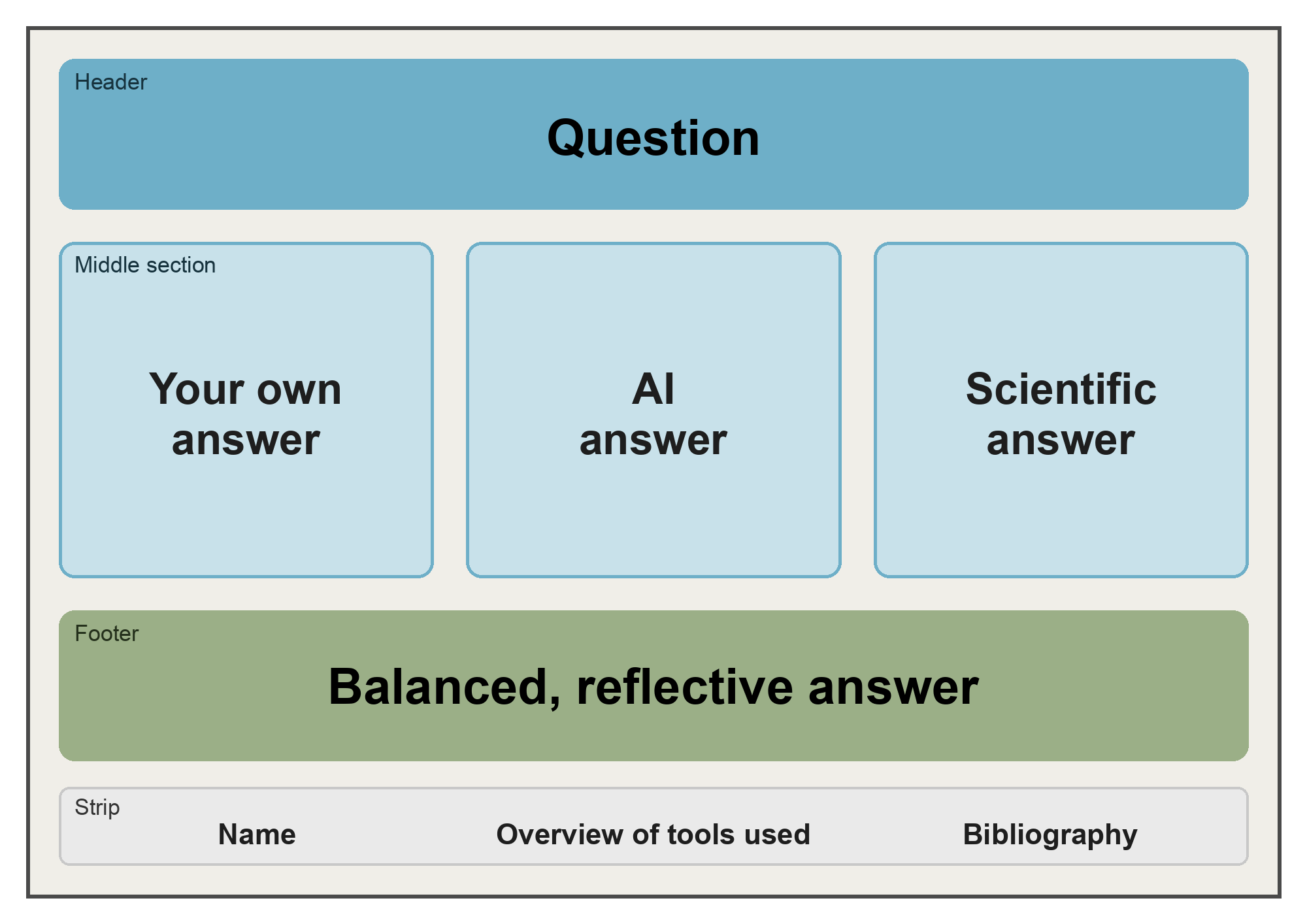
The header (German: Kopfbereich) states your question. The middle section (German: Mittelteil) shows the three answers side by side in three columns, so that the reader can compare them at a glance. The footer (German: Fußbereich) contains your balanced, reflective answer. The poster thus reads from top to bottom like the five steps themselves: from the question via three answers to your balanced, reflective answer. Below the footer, a narrow strip (German: Leiste) carries your name, your overview of tools used and your bibliography.
On the poster, too, every statement from a source carries its short reference, and the output of the AI is marked as a quotation, with its long reference and the note that it is not evidence. You create the poster in PowerPoint, export it in the Portable Document Format (PDF) and upload it in ILIAS; what makes a good poster is a topic of FTS-03. In ILIAS, everybody can view all posters, so you can see how your fellow students have answered their questions.
The two posters are not an end in themselves. They are a resource for your term paper: what you have worked out for them, you can use there. The term paper follows the same five steps – only with a company as its subject and with sources that you choose yourself.
3.5 The guide to Scientific Work
For the formal side of your work, you do not need to guess. The guide to Scientific Work describes the formal design of all written work that I supervise, and so of your term paper: the elements of a paper, layout and language, citation, the tools for academic writing, and supervision and submission. The guide is binding for your term paper. Read it carefully before you start writing; there is also a German edition on edubench.de.
You meet one of its rules in this script from the very first lesson: citation in the name-year system (German: Name-Datum-System). In the text, a short reference (German: Kurzbeleg) with the name of the author, the year and, where appropriate, the page stands at every statement taken from a source, such as (Tyler 1949, p. 63). The long reference (German: Langbeleg) follows in the bibliography (German: Literaturverzeichnis) at the end of the lesson. A table after the bibliography names the AI tools with which the lesson was created. This script follows the rules of the guide itself, so that you can see from the start what they look like in practice.
But what makes work scientific in the first place? In my book on final theses, I describe 13 general criteria of scientific work, from relevance and originality to responsibility and fairness (Jungmann 2025, pp. 11–24). In FTS-02, you get to know all 13 of them in an overview. After that, they come up again and again, wherever they fit the step of scientific work that you take next. The book is written in German; you can borrow it from the university library.
How do I get books for my studies?
Library
- borrow
- scan from the course reserve
- obtain via interlibrary loan
- suggest a purchase
Bookshop
- buy
4 The examination – your stage
4.1 The term paper
At the end of the semester, I prepare a stage for you on which you can show what you can do. In this module, the stage is a term paper (German: Hausarbeit), which each of you writes on your own.

Image by Qwen-Image 2.1
According to the examination regulations, term papers usually do not exceed 20 pages; they are produced as part of a course that they accompany, and they are submitted within a deadline set by the lecturer (HSBI 2025, p. 6). For your term paper, the guide Scientific Work sets the length: 3 000 to 4 500 words.
The subject of your term paper is an industrial company for which there is a case study that I have selected in advance. You examine it in the context of VUCA (volatility, uncertainty, complexity, ambiguity) or BANI (brittle, anxious, nonlinear, incomprehensible), and you choose a link to your own Sustainable Development Goal (SDG) from phase 1 or to your own future trend from phase 2. Your question follows a fixed pattern:
‘How does [company] deal with [dimension], and what does this mean for [SDG or trend]?’
Your term paper is structured along the five steps that you will have practised twice by then, with fixed sub-questions for each step. In phase 3, you choose your sources freely, including the sources that an artificial intelligence (AI) service names. Together with your term paper, you upload every source that you cite.
You will learn the details step by step: VUCA and BANI, the structure of the term paper and how to tailor your question in FTS-08, academic writing in the sessions that follow. Your two posters from phases 1 and 2 are your rehearsals. Stage fright is okay – it is all a matter of practice.
4.2 Submission and registration
Submission: You upload your term paper as a file in the Portable Document Format (PDF) to the ILIAS course by Friday 8 January 2027 at 23:55. This date lies in the examination period at the end of the semester. Together with the term paper, you upload all the sources that you cite. You better plan with some buffer to be prepared if Murphy’s Law hits (“Anything that can go wrong will go wrong”).
Formal design: The guide to Scientific Work applies, from the cover page to the declaration of originality. Read it before you start, not the night before the deadline.
Registration: You must be registered for the examination; otherwise you cannot complete the module this semester. How the registration works differs between the degree programmes. Find out which rules apply to your degree programme, and take care of your registration yourself – this is a matter between you and the Student Services and the examination office of HSBI.
Support: If you have questions about your term paper, ask them in the course sessions and in the Q&A forum in ILIAS. In FTS-10 or FTS-11, there is a consultation on your term paper.
Important!
Make sure that you are registered for the examination, and keep the date of submission in sight from the very beginning: Friday 8 January 2027 at 23:55.
5 What awaits you? – The semester at a glance
5.1 The semester in three phases
According to the module description, this is what you will be able to do at the end of the module:
Module description Future Technologies and Sustainability, 2025
On successful completion of the module, students are able to:
- Describe the basic economic framework conditions of German companies at home and abroad,
- Distinguish the business divisions, functions and tasks relevant to industrial engineers,
- Identify current technical trends in future technologies and social trends such as sustainability and ethical aspects of digitalisation as well as classify the effects of these trends in the development of industrial engineers’ job profile,
- Apply the VUCA model (volatility, uncertainty, complexity, ambiguity) to today’s markets and companies and discuss it,
- Identify the Sustainable Development Goals and explain the impact of companies and employees on achieving these goals,
- Summarise the necessary professional and social skills of industrial engineers.
(HSBI 2025, p. 41)
The English text is a reading aid; only the German version of the regulations is legally binding. The semester leads you there in three phases. In phase 3, the VUCA model is joined by its younger counterpart BANI (brittle, anxious, nonlinear, incomprehensible). Along the way, you reach these milestones:
| Phase | Sessions | Topic | Milestones |
|---|---|---|---|
| Start | FTS-01 · 9 October | Introduction to the module | Systems and tools set up |
| 1 | FTS-02 to FTS-04 · 16 to 30 October | Sustainable Development Goals | Question and your own answer; poster; elevator talk |
| 2 | FTS-05 to FTS-07 · 6 to 20 November | Future trends in technology and society | Question and your own answer; poster; elevator talk |
| 3 | FTS-08 to FTS-10 · 27 November to 11 December | Companies in a VUCA and BANI world | Company with case study and question; practitioner’s talk; writing session |
| End | FTS-11 · 18 December | Term paper | Consultation on your term paper, in FTS-10 or FTS-11 |
| Submission | Examination period · 8 January 2027 at 23:55 | Term paper | Term paper with all its sources uploaded in ILIAS |
All dates are in 2026, except the submission in 2027. In phases 1 and 2, you practise the five steps on a poster; in phase 3, you apply them on your own in your term paper.
5.2 The semester as a timeline
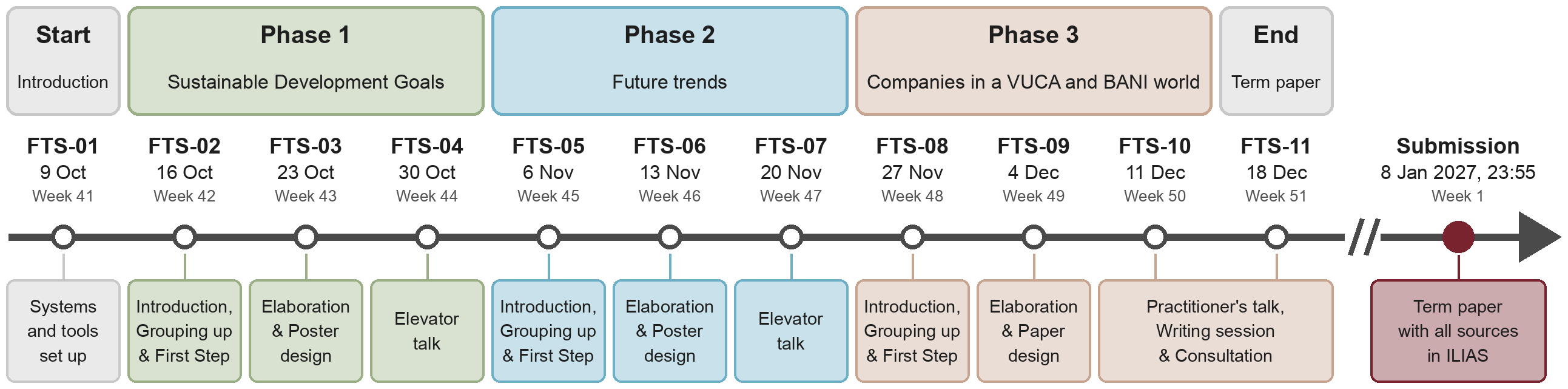
The timeline shows the same semester as a picture: the eleven sessions with their dates and calendar weeks on the arrow, the phases above it and below it what happens in each session. The break in the arrow marks the turn of the year; the submission of your term paper on 8 January 2027 completes the module.
5.3 Phase 1: The Sustainable Development Goals
In phase 1, from FTS-02 to FTS-04, we deal with the 17 Sustainable Development Goals (SDGs, German: Ziele für nachhaltige Entwicklung). With 169 targets, they are the core of the 2030 Agenda for Sustainable Development, which the General Assembly of the United Nations adopted on 25 September 2015 (United Nations 2015, pp. 1, 6). With the SDGs, the United Nations aim to end poverty and hunger everywhere by 2030, to protect the planet and its natural resources and to create prosperity and decent work for all, so that no one is left behind (ibid., pp. 1, 3). The 17 icons of the United Nations show the goals at a glance:
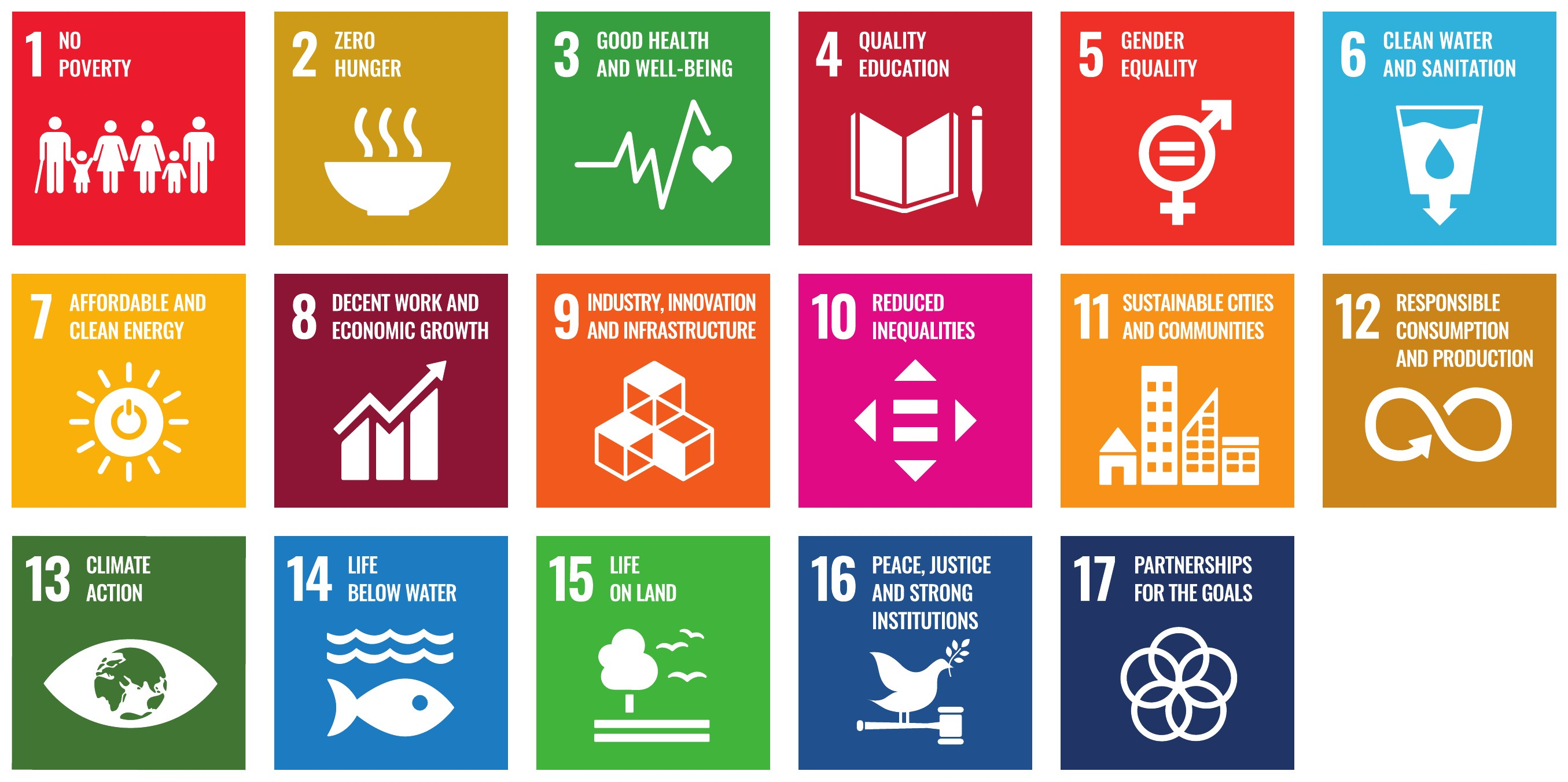
Icons: United Nations (United Nations 2023, p. 40)
The module description puts the aim of this phase like this: ‘Identify the Sustainable Development Goals and explain the impact of companies and employees on achieving these goals’ (HSBI 2025, p. 41).
This is how phase 1 works:
- In FTS-02, each of you signs up for one SDG, so that 17 SDG groups are formed. You work on a question about your SDG and write down your own answer.
- Until FTS-03, you work on your own with the artificial intelligence (AI) service specified for your group and with the source package for your SDG in Zotero.
- In FTS-03, you weigh up the three answers and complete your poster.
- In FTS-04, all of you present your question and your balanced, reflective answer, grouped by SDG, in an elevator talk (German: Elevator Talk). The posters are displayed alongside, and everybody can view them in ILIAS.
As for scientific work, phase 1 brings you the 13 criteria of scientific work in an overview and everything you need for steps 1 to 4: how to recognize a good question and choose yours, how to question an AI service, check its sources and treat its output as a quotation, and how to read a text from the source package and note where a statement comes from. In FTS-03, the focus is on weighing up – claim, evidence, conclusion – on citing on the poster, on what makes a good poster and on the structure of an elevator talk.
5.4 Phase 2: Future trends in technology and society
In phase 2, from FTS-05 to FTS-07, we look ahead: at 20 future trends (German: Zukunftstrends) that are changing the work of mechatronics engineers and industrial engineers. Nine of them are technological, such as artificial intelligence, digital twins or robotics; eleven are social, such as demographic change, mobility and urbanization or new work. According to the module description, you are to identify current technical and social trends and classify their effects on the job profile of industrial engineers (ibid., p. 41).
The 20 pictures below, one per trend, give you a first impression of what lies ahead:
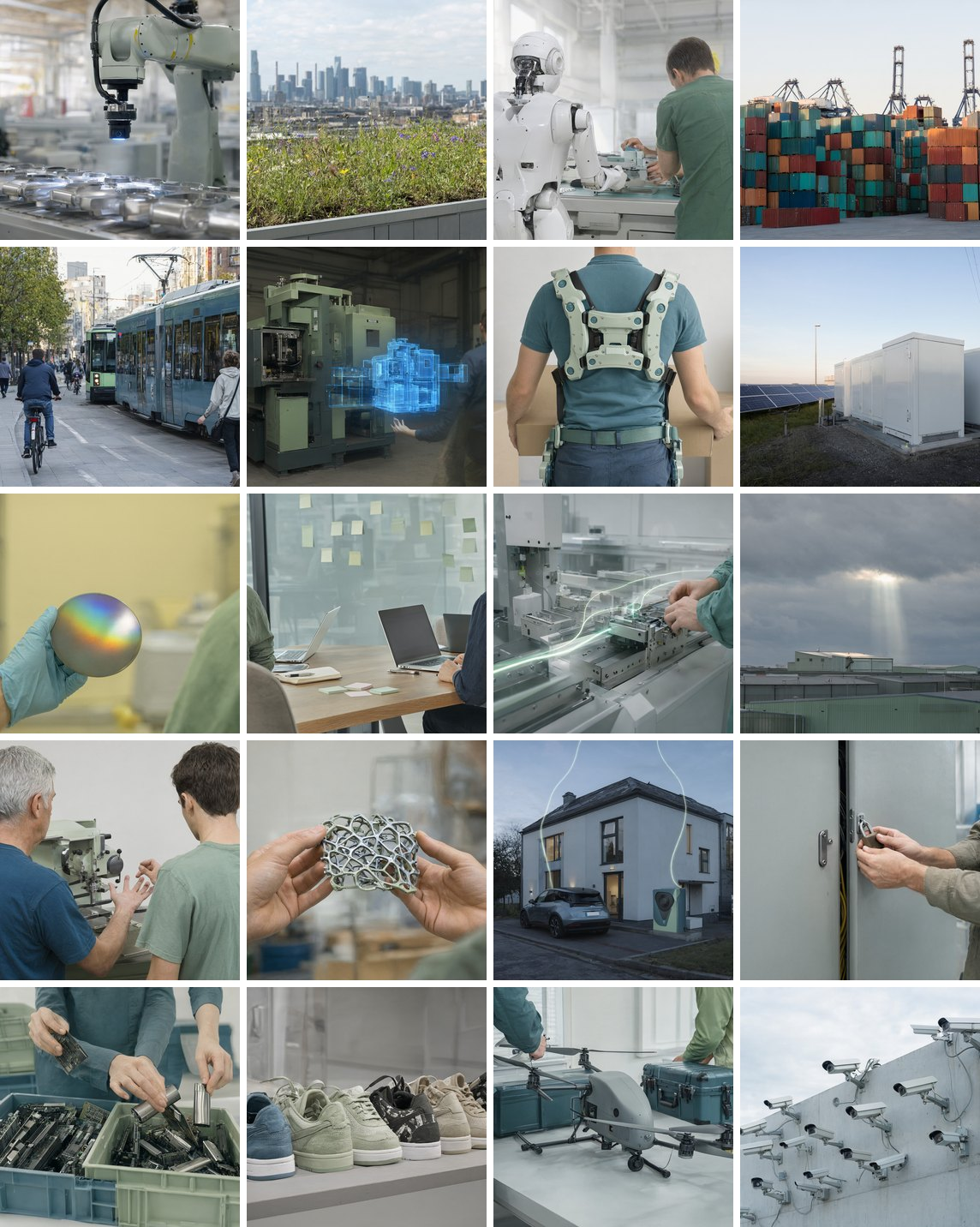
Images by Qwen 2.1
This is how phase 2 works:
- In FTS-05, each of you signs up for one trend. Each trend has four places, set up as groups in ILIAS; two of the four people share a source package. Again, you work on a question, now about your trend, and record your own answer at first – before consulting any source.
- Until FTS-06, you work with the AI service specified for your group and with your source package.
- In FTS-06, you exchange your answers in your trend group, weigh them up and complete your poster.
- In FTS-07, you present your results in an elevator talk.
As for scientific work, phase 2 is about sources. In FTS-05, you learn to evaluate them: which types of sources there are, how to recognize publications funded by industry and the interests behind them, and what a study has examined and how. You also put the same question to the AI twice and compare the answers. In FTS-06, you practise presenting an opposing position fairly, giving and receiving feedback, paraphrasing and creating a bibliography with Zotero.
5.5 Phase 3: Companies in a VUCA and BANI world
In phase 3, from FTS-08 to FTS-10, the five steps meet the reality of companies. The module description names the VUCA model – volatility, uncertainty, complexity, ambiguity – which you are to apply to today’s markets and companies and discuss (ibid., p. 41). The concept emerged at the United States Army War College in the late 1980s and found its way into books on business strategy by the early 2000s (Cascio 2020). BANI – brittle, anxious, nonlinear, incomprehensible – was proposed by Jamais Cascio in 2020 as a deliberate counterpart to VUCA, for situations that are no longer merely unstable but chaotic (ibid.). The overview below decodes both acronyms, with the origin of each model and its four dimensions:
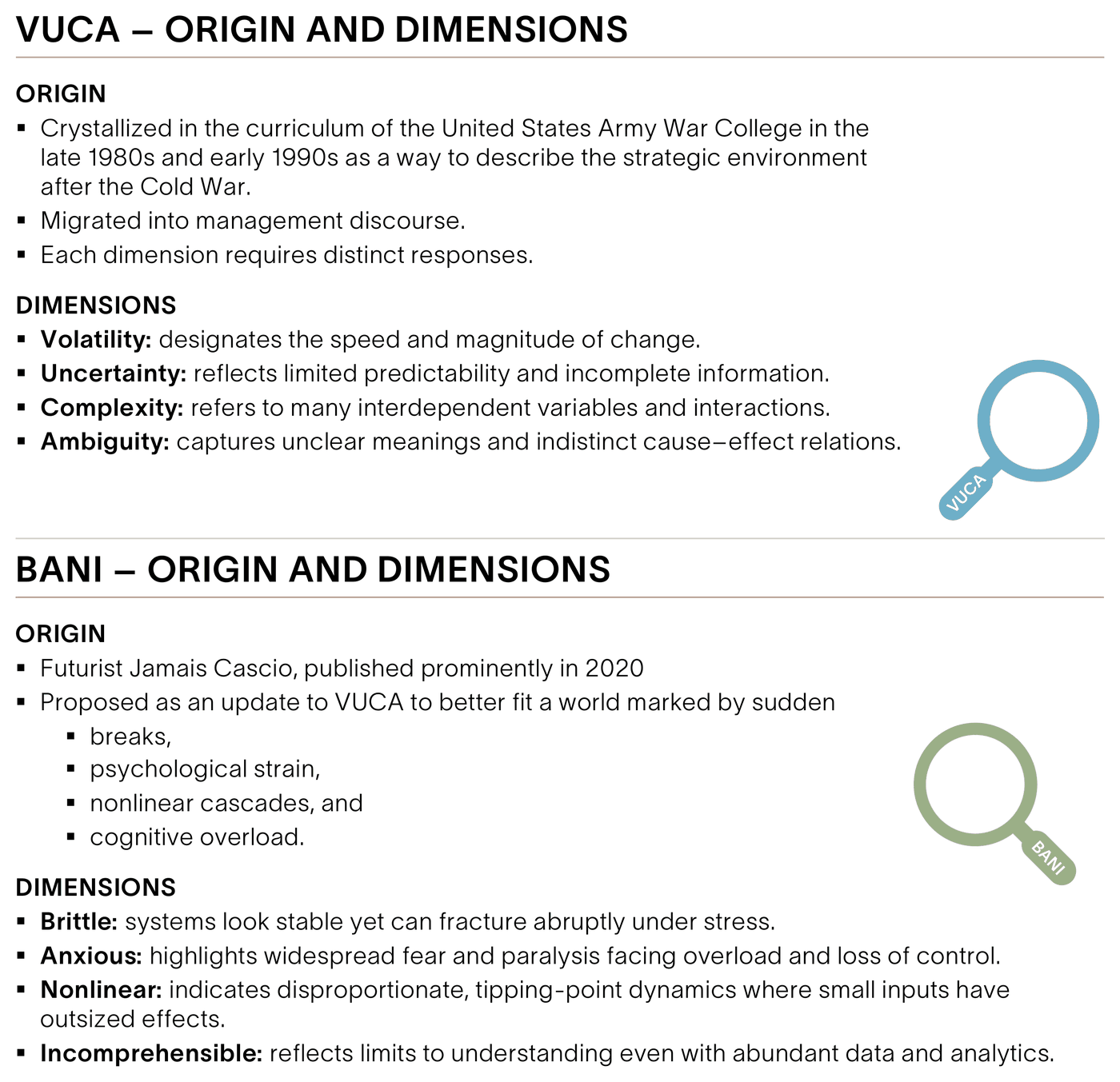
This is how phase 3 works:
- In FTS-08, I introduce VUCA and BANI. You choose a company with a case study (German: Fallstudie) from my selection, choose a dimension of VUCA or BANI and tailor your question for the term paper.
- In FTS-09, you elaborate your term paper and work on its design.
- FTS-10 and FTS-11 bring the practitioner’s talk on sustainable industries by Dr Ralf Kelle, a writing session and a consultation on your term paper, before you submit it in the examination period.
As for scientific work, phase 3 brings you everything you need for the term paper: its structure along the five steps with fixed sub-questions, the template, good scientific practice and the upload of your sources. You learn to tailor your question to the fixed pattern, to apply a model as a grid for analysing a case, and to search for sources yourself. In the writing session, you practise writing academically in English, citing in the text, creating the bibliography with Zotero, working with styles, a table of contents and captions in Word, exporting your paper for submission and naming the limits of your own work.
6 What have you learnt today? – Summary and answers to the guiding questions
6.1 The building blocks of knowledge
- Studying at university: Success comes from your behaviour: take part actively, take notes, prepare and follow up, and practise.
- Communication in the module: Ask in the session first, then in the Q&A forum in ILIAS; consultation hours via Zoom; e-mails with salutation, who you are, which module, where you have already looked and a clear question.
- Systems and tools for your studies: Your own computer, best from now on; ILIAS as the hub of the module, the chat service with artificial intelligence (AI) of HSBI (HSBIKI), the software portal and the library with its full texts; Word and Zotero with the Word plugin; this script on edubench.eu.
- Structure and organization of the module: Eleven sessions on Fridays, each with input and exercise time; this script contains the complete content.
- The didactic concept in five steps: question, your own answer, AI answer, scientific answer, weighing up – with the balanced, reflective answer as the result; the AI is an object of investigation, not a source of facts.
- Form of assessment: A term paper on a company in the context of VUCA (volatility, uncertainty, complexity, ambiguity) or BANI (brittle, anxious, nonlinear, incomprehensible), with 3 000 to 4 500 words, written on your own, structured along the five steps and submitted with all its sources in ILIAS by Friday 8 January 2027 at 23:55.
- Phase 1: Sustainable Development Goals: One Sustainable Development Goal (SDG) per person, a question, a poster and an elevator talk.
- Phase 2: Future trends: One of 20 trends per person, a question, a poster, an exchange in the trend group and an elevator talk.
- Phase 3: Companies in a VUCA and BANI world: One company with a case study, one dimension of VUCA or BANI and a link to your SDG or trend – the subject of your term paper.
6.2 Answers to the guiding questions
What awaits you in this module, and how will you show at the end what you can do?
Eleven sessions in three phases: the Sustainable Development Goals, future trends in technology and society, and companies in a VUCA and BANI world. In each session, a topic of the module meets a step of scientific work. In phases 1 and 2, you answer a question on a poster each; at the end, you show what you can do in a term paper on a company, which you submit by Friday 8 January 2027.
How do you arrive at a well-founded answer to a question such as ‘Does hydrogen make steel production climate-neutral?’
With the didactic concept in five steps: you start from the question, write down your own answer, question an AI service and check its sources, find out what scientific sources say, and weigh the three answers against each other. The result is a balanced, reflective answer, whose every statement can be traced back to its source.
Which systems and tools do you need for your studies, and where do you find them?
You need a computer of your own, best from now on. You reach the systems of HSBI – ILIAS, the chat service HSBIKI, the software portal and the library – with your HSBI login; for the virtual private network (VPN) and Microsoft 365, you also need two-factor authentication. You write in Word, and for your sources and citations, you use Zotero with the Word plugin. In the session, I show you where to find them; in the exercise FTS-01.01, you set them up step by step.
Bibliography
- CASCIO, Jamais, 2020. Facing the age of chaos [online]. 29 April 2020. Medium. Available from: https://medium.com/@cascio/facing-the-age-of-chaos-b00687b1f51d [viewed 2026-10-08].
- HSBI, 2025. Study programme examination regulations (Studiengangsprüfungsordnung – SPO) for the bachelor’s degree programme ‘Mechatronics and Automation’ at HSBI as of 15 August 2025. English reading version; the German version is legally binding. Bielefeld: Hochschule Bielefeld – University of Applied Sciences and Arts.
- JUNGMANN, Thorsten, 2025. Abschlussarbeiten aus Prüfersicht: Bachelor-, Master- oder Doktorarbeit schreiben und selbst bewerten – Leitfaden zur Bestnote [Final theses from an examiner’s perspective]. Herne: Prof. Dr. Thorsten Jungmann. ISBN 978-3-911872-02-7.
- TYLER, Ralph W., 1949. Basic principles of curriculum and instruction. Chicago and London: The University of Chicago Press.
- UNITED NATIONS, 2015. Transforming our world: the 2030 Agenda for Sustainable Development [online]. Resolution A/RES/70/1, adopted by the General Assembly on 25 September 2015. New York: United Nations. Available from: https://documents.un.org/doc/undoc/gen/n15/291/89/pdf/n1529189.pdf [viewed 2026-10-08].
- UNITED NATIONS, 2023. Sustainable Development Goals: guidelines for the use of the SDG logo, including the colour wheel, and 17 icons [online]. New York: United Nations Department of Global Communications. Available from: https://www.un.org/sustainabledevelopment/wp-content/uploads/2023/09/E_SDG_Guidelines_Sep20238.pdf [viewed 2026-10-08].
Overview of tools used
In creating this script, AI-supported software tools were used to generate and revise text and images according to my specifications:
| Product name | Access source | Software functions used | Scope of use |
|---|---|---|---|
| Perplexity | https://www.perplexity.ai | Search | Research |
| Gemini | https://gemini.google.com | Search | Research |
| Connected Papers | https://www.connectedpapers.com | Graphs of related papers | Research |
| Claude | https://claude.ai | Claude Opus and Claude Fable | Consistency checking, corrections, text revision and translation |
| Qwen-Image 2.1 | Installation on a server of the author | Text-to-image generation | Photorealistic images of everyday scenes |
Exercises for this lesson
In the exercise time of this session, you set up the systems and tools that you need from FTS-02 onwards. Work through the tasks one after the other. If you get stuck, open the step-by-step guide below the task – and help each other.
Exercise FTS-01.01 – Setting up your systems and tools
Slides for this lesson
The slides of this lesson as PDF: Slides FTS-01
⏭️ Continue with: FTS-02 Sustainable Development Goals 🔗