Prof. Dr. Thorsten Jungmann (last updated 2026-11-04)
Relates to FTS-05 Future trends in technology and society and how to evaluate sources
Task
In phase 2, you examine the question of one of the 20 future trends with the didactic concept in five steps. You present the result on a poster and in an elevator talk, and in this way, you practise on a small scale what you will do on your own in your term paper in phase 3. You start in the exercise time of FTS-05, take steps 3 and 4 on your own until FTS-06 and finish with your elevator talk in FTS-07.
Procedure
Phase 2 runs over three sessions:
- FTS-05 on 6 November, ‘Introduction, Grouping up & First Step’: In the exercise time, you sign up for one trend by joining its group in ILIAS; each trend has four places. Choose your trend by interest: you work with it until the elevator talk, and in phase 3, you can link your term paper to it. The four of you form a trend group and divide yourselves into two pairs. If your trend group has only two or three members, divide yourselves so that each of the two source packages is taken by at least one of you. If you are alone in your trend at the end of the exercise time, join a trend group that still has free places. Then you adopt the question of your trend and write down your own answer (steps 1 and 2).
- Until FTS-06: On your own, you put your question twice to the artificial intelligence (AI) service of your trend, check the sources it names and compare the two answers (step 3). You read the texts of the source package of your pair and note where each statement comes from (step 4).
- FTS-06 on 13 November, ‘Elaboration & Poster design’: You exchange your answers in your trend group, weigh up the three answers (step 5) and complete your poster.
- By Wednesday 18 November 2026 at 23:55: You upload your poster in ILIAS; everybody can view the posters there.
- FTS-07 on 20 November, ‘Elevator talk’: In your elevator talk, you present briefly and concisely, in 60 to 90 seconds, your question, your own answer, what the scientific sources say, how the AI answer fits in, and the insight you take away from the exercise.
The five steps
In phase 2, you take the five steps of the didactic concept for the question of your trend. Steps 1 to 4 are explained with an example in FTS-02, chapter 5; what is new in phase 2 is set out in FTS-05, 3.3.
1 Question
Before you sign up, read the section on the trend you have in mind in FTS-05, chapter 4. Unlike in phase 1, you do not choose your question: each trend has exactly one, and all four of you work on it. Adopt it word for word: in step 3, you put it to the AI service exactly like this, and it forms the header of your poster. In the table, 5G stands for the fifth generation of mobile communications.
| No. | Future trend | Question |
|---|---|---|
| 1 | Artificial intelligence | Do AI assistants make engineers more productive? |
| 2 | Digital twins | Do digital twins reduce the time and cost of commissioning machines? |
| 3 | Robotics and autonomous systems | Do collaborative robots pay off compared with conventional industrial robots? |
| 4 | Additive manufacturing and smart materials | Is additive manufacturing more sustainable than conventional manufacturing? |
| 5 | Energy systems and electrification | Are battery-electric or hydrogen trucks the better choice for long-haul freight? |
| 6 | Connected and software-defined production | Does 5G in factories offer benefits that Wi-Fi cannot? |
| 7 | Cybersecurity of operational technology | Should a company hit by ransomware pay the ransom? |
| 8 | Microelectronics and power semiconductors | Is silicon carbide worth its higher price in electric drives? |
| 9 | Circular economy and digital product passport | Will the digital product passport make products more circular? |
| 10 | Demographic change and shortage of skilled workers | Do ageing workforces reduce the productivity of factories? |
| 11 | Geoeconomic fragmentation and resilience | Should companies switch from just-in-time to just-in-case? |
| 12 | Security and defence | Does military research and development boost civilian innovation? |
| 13 | Mobility and urbanization | Do cargo bikes make urban deliveries more efficient? |
| 14 | Health and care | Can robots relieve the staff in elderly care? |
| 15 | Individualization | Does mass customization pay off for manufacturers? |
| 16 | Neo-ecology and climate change | Are customers willing to pay more for climate-friendly products? |
| 17 | Economic uncertainty | Should companies cut investment in times of economic uncertainty? |
| 18 | Connectivity | Does selling services instead of machines pay off for machine builders? |
| 19 | Ethics of digitalization and disinformation | Can watermarks reliably identify AI-generated content? |
| 20 | New work and lifelong learning | Does agile development work as well for physical products as for software? |
2 Your own answer
In the session, before you consult the AI service or your source package, you write down your own answer in a few sentences: What do you think – and why? Everything you already know counts, including what you have heard in the session. Distinguish what you know from what you assume: ‘I know that …’, ‘I assume that …’, ‘I am not sure whether …’. Keep your own answer as you wrote it, for example in a document in your folder for this module. On your poster, it stands unchanged in the middle section and shows where you started from (FTS-02, 5.2).
3 AI answer
Until FTS-06, you put your question word for word to the AI service that is specified for your trend; both pairs of a trend use the same service:
| AI service | Access | Trends |
|---|---|---|
| ChatGPT | https://chatgpt.com | 1, 7, 13, 19 |
| Perplexity | https://www.perplexity.ai | 2, 8, 14, 20 |
| Claude | https://claude.ai | 3, 9, 15 |
| Gemini | https://gemini.google.com | 4, 10, 16 |
| Vibe by Mistral AI | https://chat.mistral.ai | 5, 11, 17 |
| Grok | https://grok.com | 6, 12, 18 |
If registering with this service is an obstacle for you – some services ask for a mobile phone number, for example – use the chat service with artificial intelligence of HSBI (HSBIKI) instead: HSBIKI Chat at https://www.hsbi.de/dvz/hsbiki/chat
You put your question to the service twice: word for word, with the same service and the same model and mode, in a new chat (FTS-05, 2.5). If your service can remember earlier chats, ask both times in a temporary chat without memory, where it offers one. If you cannot choose the model or the mode, leave them as they are and note this. Save both complete answers, each together with the date, the name of the service and, where the service shows them, the model and the mode, for example an instant or a thinking mode. Then check the answers like a reviewer (FTS-02, 5.3):
- Which sources does the AI service name? List all of them.
- Do these sources exist?
- Do the sources say what the AI service claims?
Finally, compare the two answers: Does the answer to the question stay the same? Do the figures stay the same? Does the service name the same sources?
4 Scientific answer
Until FTS-06, you read the texts of the source package of your pair in the Zotero group FTS-resources-2. This is a new group: ask to join it at https://www.zotero.org/groups/fts-resources-2 and wait for my approval. Your pair agrees with the other pair who takes which source package: one pair uses the collection ending in -A, the other the collection ending in -B, for example ‘Phase2-Trend07-A’ and ‘Phase2-Trend07-B’ for trend 7.
Read each text in passes: overview, content, depth (FTS-02, 5.4). Read it with the tools from FTS-05, chapter 2: What type of source is it? Who wrote it, and who paid for it? What has it examined, and how? Note the answers together with the statements you want to use. Note every statement in your own words, with the short reference and the page, and distinguish what the authors have found from what they assume or recommend. From your notes, you formulate the scientific answer to your question.
5 Weighing up
In FTS-06, this time after an exchange in your trend group, each of you weighs the three answers against each other: Where do they agree, where do they contradict each other, and why? The result is your balanced, reflective answer. You know how to weigh up from FTS-03, chapter 1. Take steps 3 and 4 before FTS-06: for the exchange in your trend group, you need your own answer, the AI answers and the scientific answer.
Result
Each of you makes a poster of your own: a single slide in landscape format with a fixed layout, as in phase 1:
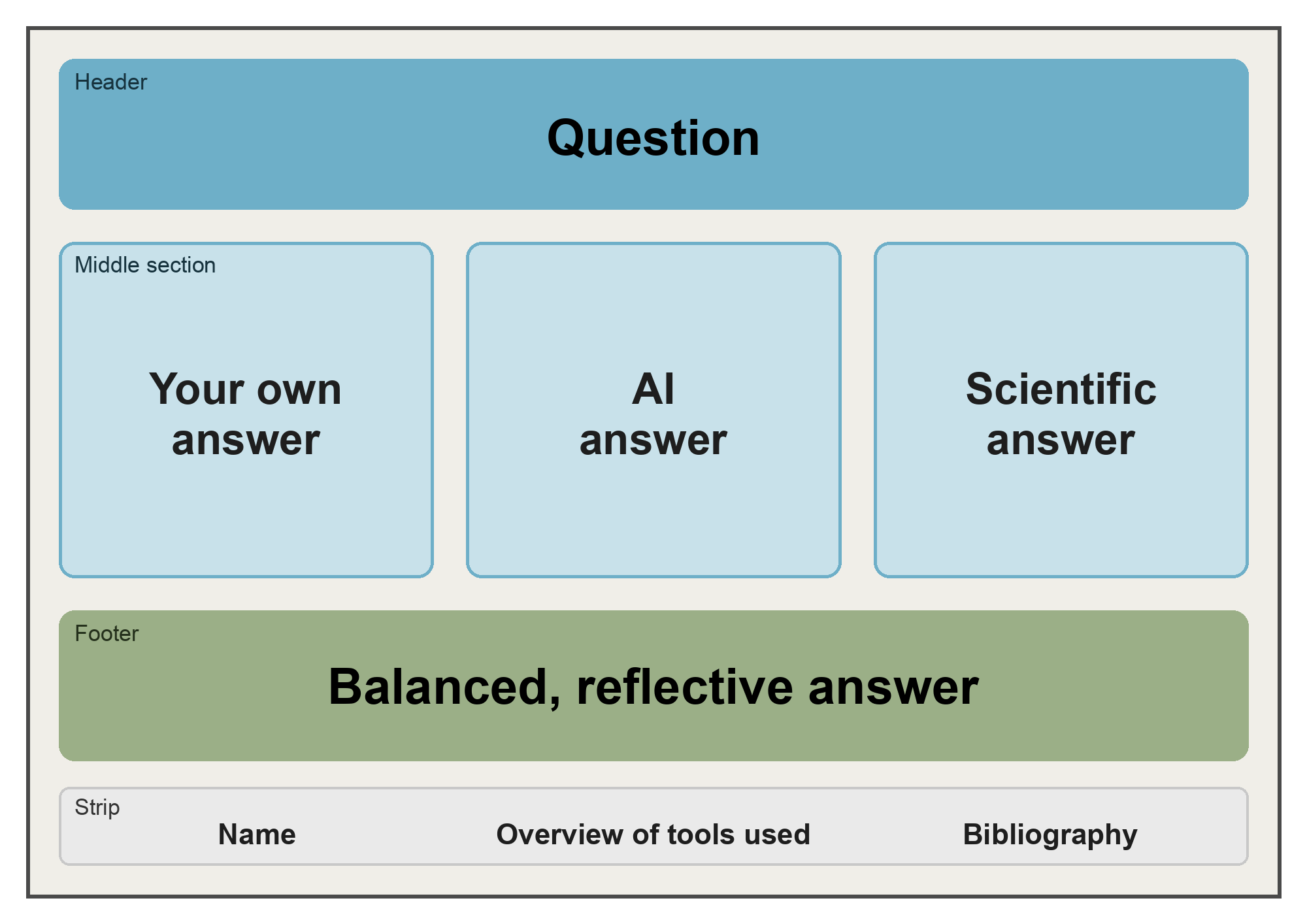
- Header: your question, word for word, and your trend below it.
- Middle section: three columns side by side – your own answer, the AI answer and the scientific answer. In the column for the AI answer, you quote what you examine from both answers and report your check of the sources they name and what the comparison has shown.
- Footer: your balanced, reflective answer, which compares the AI answer with the scientific answer.
- Strip at the bottom: your name, your overview of tools used and your bibliography.
You know what makes a good poster from FTS-03, chapter 2 and how to get from the template to the finished file from FTS-03, 3.3.
Requirements
- AI service: the service specified for your trend; if registering with it is an obstacle for you, HSBIKI Chat.
- Scientific sources: In phase 2, you take the scientific sources for your poster from the source package of your pair.
- Your own answer: written in the session, before you consult the AI service or your source package, and on your poster as you wrote it.
- The AI answer is never a source and never evidence: you quote each of the two answers only to examine it – verbatim in quotation marks or paraphrased, always with the long reference directly at the quotation (the product, the access source, the model and the mode and the date of your query) and with the note that the quotation is not evidence. It never gets a short reference, and its long reference stands nowhere else.
- Data and facts never come from the AI service: they come from a scientific source, or you do not use them.
- Citing: Every statement from a scientific source carries its short reference with the page, according to the guide to Scientific Work, and your bibliography lists exactly the sources you cite. The AI service whose answers you examine appears in your overview of tools used, as a tool and not as a reference (FTS-03, 4.4).
- Pictures: Every picture on your poster that you have not created yourself carries its source.
Submission
Upload your poster as a single file with one page in the Portable Document Format (PDF) in the exercise ‘Poster upload’ in the group of your trend in ILIAS, by Wednesday 18 November 2026 at 23:55.